 how-to
Is a Portable Solar Generator Worth It for Home Backup?
Table of Contents
- How a Portable Solar Generator Works and Where It Fits in Home Backup
- Solar Generator Capacity and Watt-Hours: The Numbers That Actually Matter
- How Long Will a Solar Generator Run a Refrigerator?
- Solar Generator Pros and Cons for Home Backup
- Portable Power Station vs. Home Battery Backup: Which Fits Your Outage Pattern?
- Running the Numbers: Load Calculation, Outage Duration, and Cost per kWh
- Safe Home Connection, Transfer Switches, and What a Portable Unit Cannot Do
- Conclusion: Deciding If a Portable Solar Generator Is Worth It for Your Home
- Frequently Asked Questions
Last Updated: October 6, 2026
How a Portable Solar Generator Works and Where It Fits in Home Backup
Here is the honest answer up front: a portable unit is worth it for short outages and small loads, but it is not a whole-home solution.
That distinction matters more than any spec sheet. According to the U.S. Department of Energy's energy storage overview, battery storage works best when it is matched to a specific load, not sized by guesswork.
Most buyers skip that matching step. They buy on wattage alone, then discover the unit cannot start a fridge compressor or run for more than a few hours.
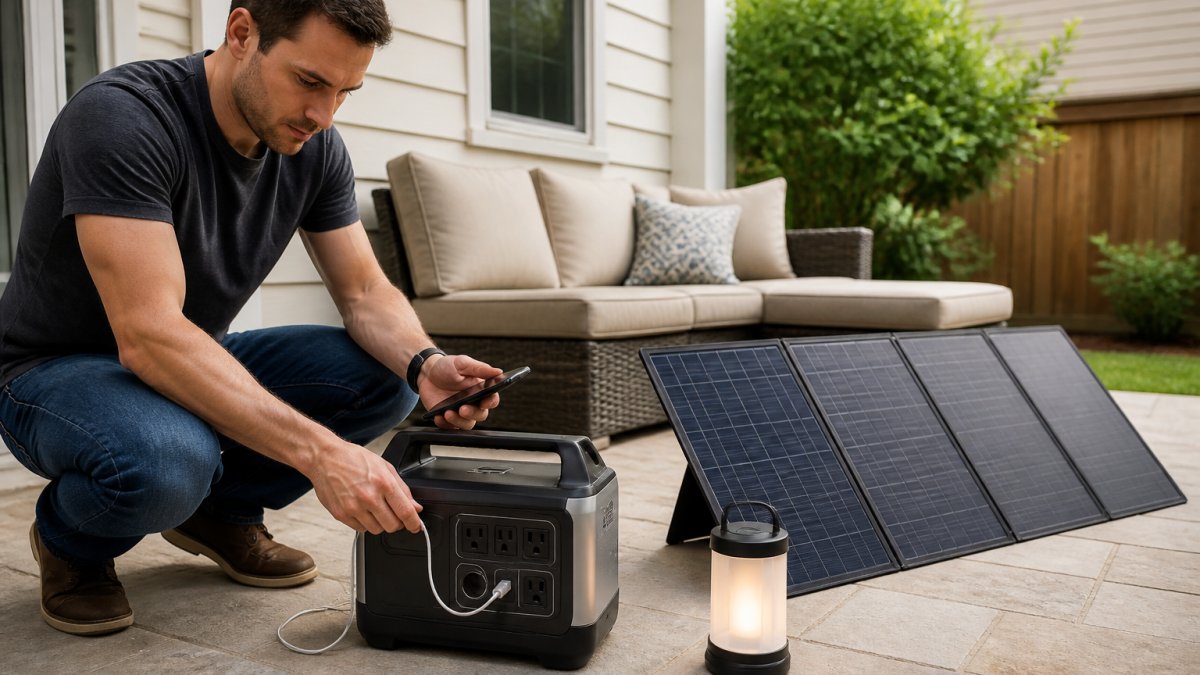
Three charging paths keep these units flexible:
- Solar panels for clean energy during daylight
- AC charging from a wall outlet for fast top-ups
- Car charging for travel and tailgating
So where does it fit? Think of it as a bridge between a flashlight and a whole-home system.
Solar Generator Capacity and Watt-Hours: The Numbers That Actually Matter
Capacity is the number most buyers get wrong. Rated watt-hours are not the same as usable watt-hours, and the gap between them decides how long your gear actually runs.
Usable Capacity vs. Rated Capacity
Manufacturers list total battery capacity, but most units hold back a reserve to protect the battery. A unit rated at 1,000 watt-hours may only deliver 800 to 900 usable watt-hours.
That reserve is not a flaw. It extends cycle life and prevents deep discharge damage. But it means your real runtime is always lower than the box suggests.
Continuous Wattage, Surge Wattage, and Pure Sine Wave Output
Continuous wattage is what a unit can supply steadily. Surge wattage is the brief spike it can handle when a motor starts.
A refrigerator may run at 150 running watts but spike past 1,000 watts at startup. If your unit's surge rating is too low, it will trip.
Pure sine wave output matters too. Motors, routers, and medical devices run cleaner on it. Modified sine wave power can cause buzzing, overheating, or device errors.
How Long Will a Solar Generator Run a Refrigerator?
A typical full-size refrigerator draws about 150 running watts, so a unit with 1,000 usable watt-hours can run it for roughly six hours before other loads are added.
Compressors cycle on and off, so actual draw varies.
Here is the practical rule we give homeowners:
| Device | Running Watts | Surge Watts | Notes |
|---|---|---|---|
| Refrigerator | 150 | 1,000+ | Cycles on and off |
| Router | 15 | 20 | Runs constantly |
| LED lights | 10 each | 10 | Low draw |
| Phone charger | 10 | 10 | Minimal |
| Laptop | 60 | 90 | Moderate |
Add those up and a modest load lands near 250 running watts. Double the fridge draw for surge, and you need a unit with real headroom.
Solar Generator Pros and Cons for Home Backup
The solar generator pros and cons come down to one trade-off: portability versus raw power.
Pros:
- No fuel, no fumes, no noise
- Safe to run indoors or in a garage
- Recharges from the sun during long outages
- Works for camping, tailgating, and job sites too
Cons:
- Limited capacity for big loads like central AC or a well pump
- Solar charging speed depends on panel wattage and weather
- Battery degradation shortens capacity over time
- Not a substitute for a transfer switch and whole-home wiring These inherent limitations often lead homeowners to consider whether a more permanent solar battery storage installation might better serve their specific regional climate needs.
A gas generator wins on raw output and runtime. A portable solar generator wins on safety, silence, and zero fuel runs.
For a remote worker, the quiet operation is the whole point. You can keep a router and computer running in a home office without carbon monoxide risk.
Portable Power Station vs. Home Battery Backup: Which Fits Your Outage Pattern?
A portable power station is a plug-and-play unit you carry room to room. A home battery backup is a permanently installed system wired into your electrical panel.
The right choice depends on your outage pattern, not your budget alone.
| Factor | Portable Power Station | Home Battery Backup |
|---|---|---|
| Best for | Short outages, small loads | Multi-day outages, whole-home |
| Installation | None | Licensed electrician required |
| Runtime | Hours | Day or more |
| Powers central AC | No | Often yes |
| Portability | High | None |
If your outages last two to four hours, a portable unit handles it. If ice storms knock out power for days, a portable unit becomes a triage tool, not a solution.
Take our 60-second quiz for a free quote today! →
That is where a professionally installed system earns its place. The Federal Emergency Management Agency's power outage guidance notes that extended outages create real safety risks, especially for medical devices and temperature-sensitive supplies.
Running the Numbers: Load Calculation, Outage Duration, and Cost per kWh
Guessing at capacity is how people end up disappointed. Here is the calculation we walk homeowners through.
Step-by-Step Household Load Calculation
- List every device you want to run during an outage
- Write down each device's running watts
- Note which devices have a startup surge
- Multiply watts by hours of use per day
- Add the totals for your daily watt-hour need
- Add 20 percent headroom for surge and inefficiency
A fridge at 150 watts for eight hours a day equals 1,200 watt-hours. A router at 15 watts for 24 hours adds 360. Lights and chargers add a few hundred more. Suddenly you need a much bigger unit than expected.
Battery Aging, Warranty, and Replacement Economics
Battery capacity fades with every charge cycle. Lithium iron phosphate batteries generally hold up better than older lithium-ion chemistries, and most manufacturers publish a cycle life rating.
Check three things before buying:
- Cycle life rating at a stated capacity retention level
- Warranty length and what it actually covers
- Whether the battery is replaceable or the whole unit is disposable
A unit with a replaceable battery has a longer useful life. A sealed unit becomes e-waste the day the battery fades.
Safe Home Connection, Transfer Switches, and What a Portable Unit Cannot Do
There are two very different ways to use a portable solar generator during an outage, and confusing them is where people get hurt.
Direct connection means you plug devices straight into the unit's AC outlets, a lamp, a phone charger, a fridge on an extension cord, a CPAP machine.
Household circuit connection means feeding power into your home's wiring so wall outlets, lights, and hardwired appliances work normally.
Why Backfeeding Is Dangerous and Usually Illegal
Plugging a portable generator into a regular wall outlet to "backfeed" your panel is dangerous and illegal in most jurisdictions. It can electrocute utility workers who are repairing lines they believe are de-energized, and it can damage your wiring and the unit.
The Occupational Safety and Health Administration's electrical safety standards exist precisely because backfeeding and improvised connections cause real injuries. The risk is not theoretical, it is the reason utility crews treat every downed line as live until proven otherwise.
When You Actually Need a Transfer Switch
If you want a portable generator to power household circuits, not just devices plugged into it, you need a code-compliant way to isolate your home from the grid. That means one of two setups:
- A manual transfer switch installed by a licensed electrician. It lets you flip specific circuits from grid power to generator power, and it physically prevents the two sources from ever connecting at the same time.
- A generator inlet box wired to a transfer switch or an interlock kit on your main panel. You run a cord from the generator to the inlet, and the interlock mechanically blocks the main breaker from being on while the generator breaker is on.
Both approaches require a licensed electrician in most jurisdictions, a permit in many, and an inspection in some. The cost is real, but it is the difference between a legal, safe install and a hazardous improvisation.
What a Portable Unit Cannot Do
Even with a proper transfer switch, a portable solar generator has hard limits:
- Run central air conditioning. A central AC compressor can draw 3,000 to 5,000 running watts and spike far higher at startup. Very few portable units can start one, and none can run one for long.
- Power a well pump or sump pump for long. These are surge-heavy, hardwired loads. A portable unit may start a small pump, but runtime will be short and the surge may trip the inverter.
- Replace a whole-home standby system. A standby generator or a permanently installed home battery is sized to your panel and runs automatically. A portable unit is manual, limited, and load-dependent.
- Carry a multi-day outage without constant recharging. Runtime is measured in hours, not days, unless the load is tiny and the sun cooperates.
- Power 240-volt loads. Most portable units output 120 volts only. Electric dryers, electric ranges, central AC, and many well pumps need 240 volts.
Matching the Tool to the Job
If your goal is keeping phones, a router, a few lights, and a fridge alive for a few hours, direct connection is all you need and no electrician is required.
If your goal is whole-home coverage through a multi-day storm, the conversation shifts to installed systems. At Generators of Nashville by Evolution Electric, our licensed electricians have specialized in setting up Generac generators, solar arrays, and advanced home battery systems like EcoFlow, Anker SOLIX, and Jackery since 2014.
Conclusion: Deciding If a Portable Solar Generator Is Worth It for Your Home
Is a portable solar generator worth it for home backup? For short outages and small loads, yes. For multi-day storms and whole-home coverage, no.
The deciding factor is your outage pattern. Two-hour blips favor a portable unit. Multi-day ice storms favor a professionally installed system with a transfer switch.
If you want to know which side of that line your home falls on, take our 60-second quiz for a free, personalized quote.
Frequently Asked Questions
What are the downsides of a portable solar generator for home backup?
The main limits are capacity and recharge speed. Most portable units hold 1 to 4 kWh, enough for essentials like a refrigerator, router, lights, and phone charging, but not central AC or a whole-home load. Solar recharge depends on sun and panel wattage, so a cloudy day can stretch recharge time. Battery chemistry matters too: lithium iron phosphate packs typically last more cycles than older lithium-ion designs, but all batteries lose capacity over time.
How long will a 2,000-watt solar generator run a refrigerator?
A typical full-size refrigerator draws 100 to 200 running watts with a startup surge that can briefly hit 800 to 1,200 watts. A 2,000-watt portable solar generator with roughly 2 kWh of usable capacity can run that refrigerator for about 10 to 20 hours, depending on ambient temperature, how often the door opens, and how full it is. Check the unit's continuous and surge wattage ratings before relying on it for a fridge.
Is a portable solar generator enough to power a house?
Not a whole house. A portable solar generator is designed for essential appliances and short outages, not central HVAC, electric ranges, or well pumps running at once. If your goal is keeping the whole home powered through multi-day outages, a home battery backup or standby generator sized to your load is the better fit. A portable unit works well as a bridge for phones, routers, medical devices, and a refrigerator.
Can you recharge a portable solar generator during a power outage?
Yes, that is one of its advantages. Solar panels can recharge the unit during an outage as long as you have sun and the panels are not blocked. You can also recharge from a car outlet or a portable fuel generator if needed. Recharge speed depends on panel wattage and solar input limits on the unit, so a 400W panel array will refill a 2 kWh battery faster than a single 100W panel.