 How-to
How to Calculate Generator Fuel Consumption for 24 Hours
Quick Summary
To calculate generator fuel consumption for 24 hours, split the day into blocks at different load levels, read each block's hourly rate from your model's chart, multiply rate by hours, and add the totals. Converting each block's rate to a gallons-per-hour figure before summing keeps the math consistent.
- Pull rated output, fuel type, and expected load from the data plate or owner's manual.
- Convert your appliance wattage to a percentage of the generator's rated output.
- Read each load level's hourly gallon rate from the manufacturer's consumption chart.
- Multiply each block's rate by its hours, then add all blocks for the daily total.
- Store extra fuel as a reserve, adding 25 to 50 percent to cover delays and load creep.
Table of Contents
- Why 24-Hour Fuel Consumption Is Harder to Estimate Than It Looks
- Step 1: Gather Your Generator's Rating, Fuel Type, and Load Figures
- Step 2: Use a Generator Fuel Consumption Chart to Find Your Hourly Rate
- Step 3: Work Through a 24-Hour Calculation with Variable Loads
- How Many Gallons of Gas to Run a Generator for 24 Hours
- Using a Generator Fuel Consumption Calculator and Converting Units
- Planning Your Fuel Reserve and Measuring Actual Use in the Field
- Booking a Load Assessment Before Your Next Outage
- Frequently Asked Questions
Why 24-Hour Fuel Consumption Is Harder to Estimate Than It Looks
Most homeowners assume a generator burns the same amount of fuel every hour. It doesn't. A generator's draw changes with every appliance that cycles on, so a flat estimate often misses the mark by a wide margin.
Calculating fuel use for a full day means you have to account for four things: the generator's rated output, the fuel type, the percentage of that output your home actually uses, and how long each load level lasts. Miss one, and your fuel plan falls short when the power is out and you need it most.
Watch out: Your air conditioner's starting surge can briefly push draw far above its running load. Plan for that spike, not just the steady number on the label.
Step 1: Gather Your Generator's Rating, Fuel Type, and Load Figures
Start with three numbers. Pull them from the data plate on the generator or the owner's manual.
- Rated power output: Listed in kilowatts (kW) or kilovolt-amperes (kVA).
- Fuel type: Gasoline, diesel, propane, or natural gas.
- Expected load: The total wattage of the circuits you plan to run during an outage.
Add up the running watts of the appliances you want powered. A refrigerator might draw 700 watts while running, while a central air conditioner can pull several thousand. Use the nameplate figures, not guesses.
Then convert your load to a percentage of the generator's rating. A 10 kW unit carrying a 5 kW load runs at 50 percent. That percentage is the key to the next step.
Step 2: Use a Generator Fuel Consumption Chart to Find Your Hourly Rate
A generator fuel consumption chart maps load percentage to gallons per hour. Manufacturers publish these charts for each model, and they are the most reliable starting point.
Find your unit's rating on the chart. Then read across to the row that matches your load: 25 percent, 50 percent, 75 percent, or 100 percent. The figure there is your approximate hourly rate in gallons.
Here is what the pattern usually looks like:
| Load Level | Fuel Use Trend | Best Use |
|---|---|---|
| 25% | Lowest hourly burn | Lights, fridge, router |
| 50% | Moderate burn | Fridge, freezer, some HVAC |
| 75% | Higher burn | Central AC plus essentials |
| 100% | Highest burn | Full rated capacity |
Fuel use does not rise in a straight line with load. Running at a higher percentage usually burns more fuel per kilowatt delivered, so a generator run lightly is often more efficient. Use the chart for your exact model because these trends vary by engine.
Step 3: Work Through a 24-Hour Calculation with Variable Loads
Real outages rarely hold one load for 24 hours. The AC cycles on and off, the well pump kicks in, and cooking adds a spike at dinner time. Build the day in blocks, and state every assumption so the math can be checked.
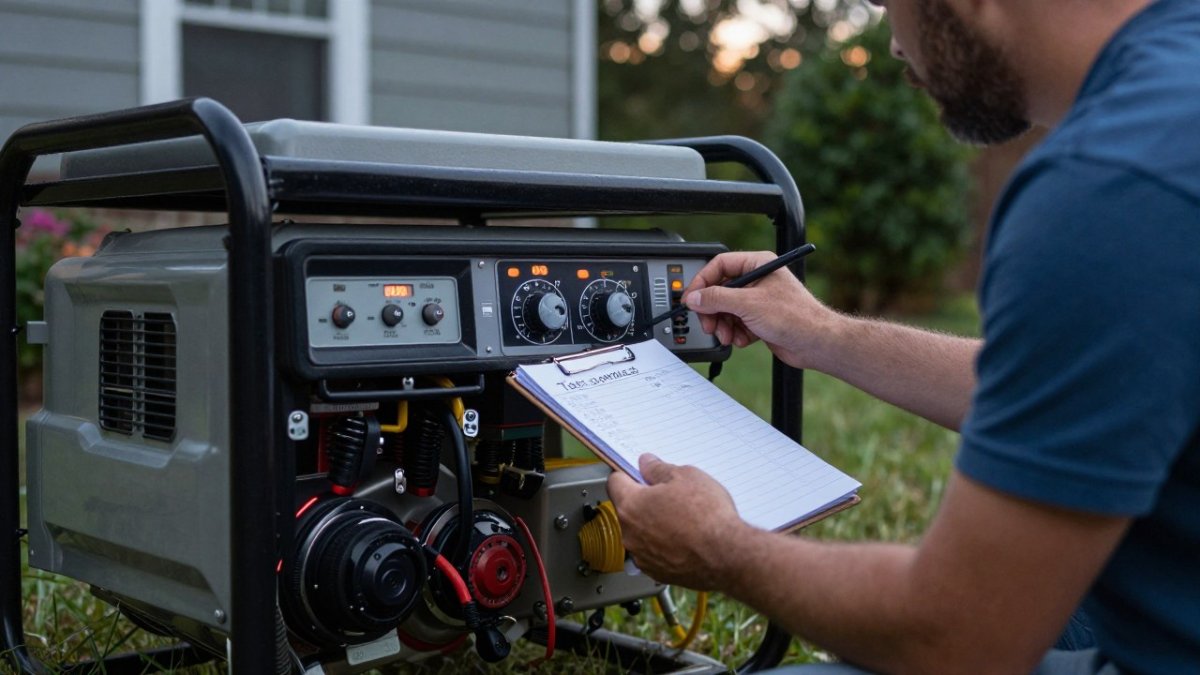
Here is a fully worked example for a 10 kW gasoline generator using a manufacturer-style consumption chart. The chart values below are illustrative; swap in your own model's chart.
| Time block | Hours | Load level | Load (kW) | Chart rate (gal/hr) | Fuel used (gal) |
|---|---|---|---|---|---|
| Overnight | 8 | 40% | 4.0 | 0.6 | 4.8 |
| Daytime | 10 | 70% | 7.0 | 1.1 | 11.0 |
| Evening | 6 | 90% | 9.0 | 1.5 | 9.0 |
| Total | 24 | , | , | , | 24.8 |
Fuel used (gal)
Add the segments: 4.8 + 11.0 + 9.0 = 24.8 gallons for the day. The stated assumptions are a 10 kW rated output, gasoline fuel, and chart rates of 0.6, 1.1, and 1.5 gallons per hour at 40%, 70%, and 90% load. Change any one of those and the total changes.
For a variable-load day, the general formula is:
Daily fuel = (rate₁ × hours₁) + (rate₂ × hours₂) + … + (rateₙ × hoursₙ)
where each rate comes from the chart at that block's load percentage. If your chart only lists 25%, 50%, 75%, and 100%, interpolate between the two nearest rows and note that you did so.
A more realistic schedule often has more than three blocks. A summer day with a central AC might look like 6 hours at 35%, 8 hours at 55%, 6 hours at 80%, and 4 hours at 95%. Four blocks is still easy to add by hand and captures the AC cycling better than one flat rate.
Watch out: A single 24-hour average load hides peaks. If your generator runs near 100% for several hours, the chart rate at that load is what drains the tank, not the daily average.
State your assumptions clearly in writing: generator rating, fuel type, chart source, load levels, and hours at each level. A calculation you can explain is one you can trust and adjust later when the outage lasts longer than planned.
How Many Gallons of Gas to Run a Generator for 24 Hours
There is no single gallon figure that fits every generator, because the answer depends on rated output, load, and fuel type. What you can do is bound the estimate and then convert it correctly for each fuel.
Gasoline use depends on the unit's rated output and load, so the segment method in Step 3 and the manufacturer's chart for your model give the most reliable number for your unit.
Diesel is more energy dense, so it typically burns less volume per hour at the same load, but it still scales with load. Diesel charts are usually published in gallons per hour just like gasoline, so the same segment math applies once you have the right chart.
Propane and natural gas are measured in different units, which is where most estimates go wrong. Propane is sold by the gallon or by the pound, and natural gas is billed in cubic feet or therms. Do not plug a gasoline gallons-per-hour rate into a propane or natural gas plan.
Use these conversions to keep units consistent:
- 1 U.S. gallon = about 3.785 liters.
- 1 U.S. gallon of propane weighs about 4.2 pounds, so a 20-pound tank holds roughly 4.7 gallons.
- 1 kW = 1,000 watts; 1 kVA = 1,000 volt-amperes.
- For a purely resistive load, kW and kVA are equal; for motor loads, kW is lower than kVA by the power factor.
A fuel-specific check: if your chart is in gallons per hour but your tank gauge reads in pounds or cubic feet, convert before you subtract. Mixing units is the most common reason a 24-hour estimate comes out wrong.
Watch out:
For any fuel, the reliable path is the same: get the manufacturer chart for your exact model and fuel, run the segment math, and then convert the result into the unit your tank or supplier uses.
Using a Generator Fuel Consumption Calculator and Converting Units
A generator fuel consumption calculator does the arithmetic for you. Enter the rated output, fuel type, and load percentage, and it returns an hourly rate and a daily total. Many manufacturer sites offer one for free.
Use the calculator as a check on your own work, not a replacement for it. Two common errors cause mismatches:
- Unit mix-ups: Kilowatts and kilovolt-amperes are not identical. Confirm which one the chart uses.
- Gallons versus liters: One U.S. gallon equals about 3.785 liters. Keep every figure in the same unit before you add them.
Run the numbers both ways. If the calculator and your segment math agree within a gallon or two, your plan is solid.
Planning Your Fuel Reserve and Measuring Actual Use in the Field
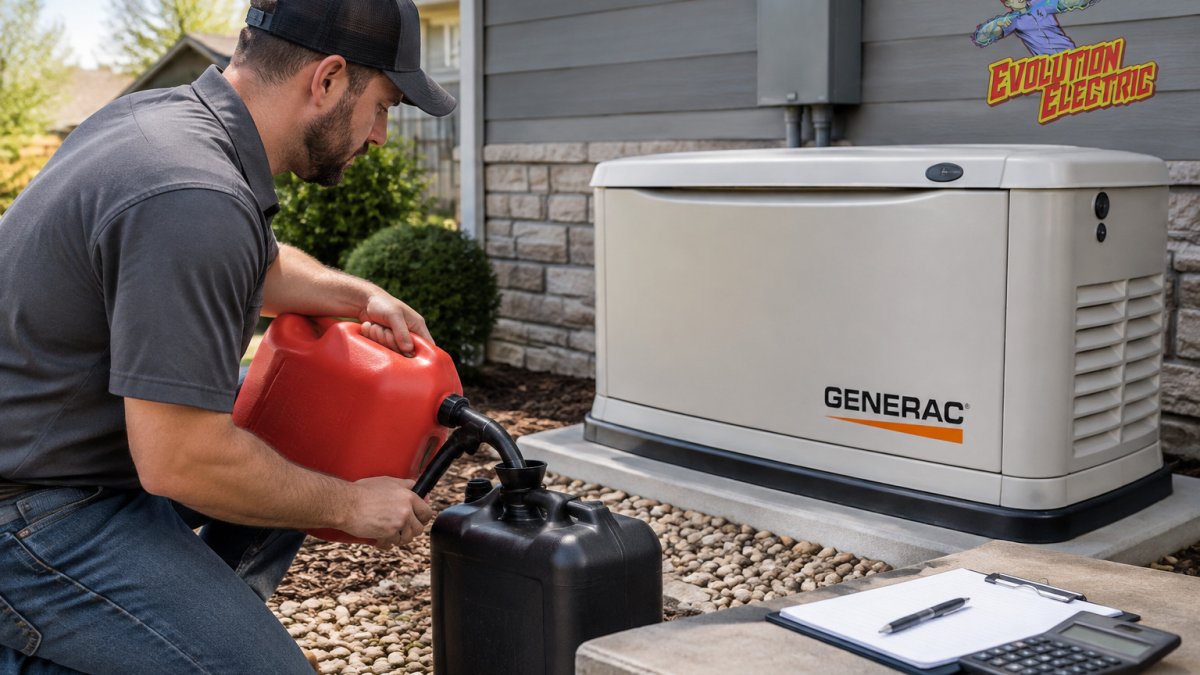
A calculation is an estimate until you measure real use. Once your generator runs, note the fuel level at the start and end of each load period. Compare the actual burn to your projection and adjust.
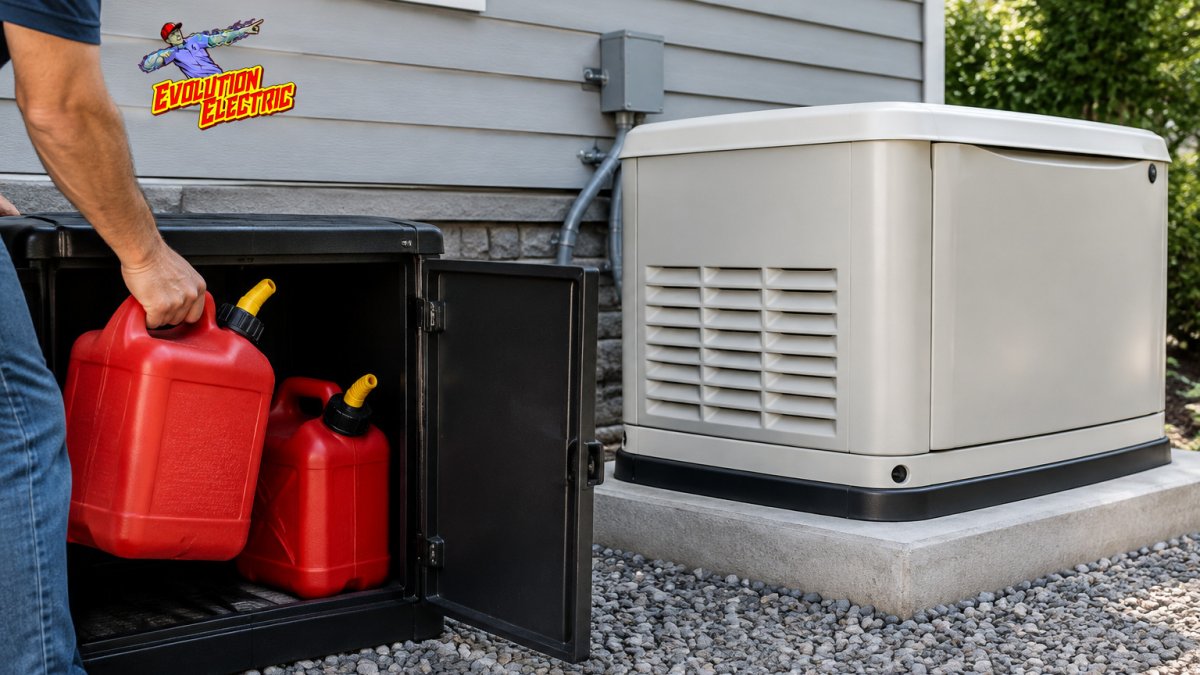
Build a reserve on top of your estimate. Many homeowners add 25 to 50 percent extra for weather delays, restocking trips, and load creep. Store fuel safely, away from living spaces and in approved containers.
If your generator keeps running rough or burning more fuel than expected, check the basics first. Our guide on Troubleshooting Common Standby Generator Issues in Nashville covers the most frequent causes. Regular service also keeps consumption predictable, so the Residential Generator Maintenance Tips: 7 Essential Steps article is a useful next read.
Booking a Load Assessment Before Your Next Outage
Your numbers are only as good as your load figures. A load assessment checks what your home actually draws, so your fuel plan and generator size match reality. Generators of Nashville, powered by Evolution Electric, provides expert installation of backup power solutions for homeowners throughout Middle Tennessee.
If you are still deciding between a generator and battery backup, the Backup Power Solutions for Frequent Outages: Sizing, Cost, and Choice guide compares sizing and cost before you commit.
Take our 60-second quiz for a free, personalized quote on your whole-home backup system.
Frequently Asked Questions
How many gallons of gas to run a generator for 24 hours?
A generator's gasoline use depends on its rated output and how heavily it is loaded. Check the fuel consumption table in your generator's manual, since models differ. Multiply the hourly rate by 24, then add a reserve of 10 to 20 percent so an unexpectedly long outage does not leave you short.
Does generator fuel consumption change with the electrical load?
Yes. A generator uses more fuel as the electrical load rises, but not in a straight line. An engine running at light load is less efficient per kilowatt-hour, so the fuel burned per hour rises gradually from idle to full load. For this reason, a generator running at 25 percent load does not use one quarter of the fuel it uses at full load. Estimating at a realistic average load, rather than the maximum nameplate rating, gives a far more accurate 24-hour figure.
How do I estimate diesel generator fuel use per hour?
Start with the fuel consumption chart from the manufacturer, which lists gallons per hour at 25, 50, 75, and 100 percent load. Find the load level closest to your expected operating load, then read the hourly rate. Diesel generators typically consume less fuel per kilowatt-hour than gasoline units, so the per-hour figure is usually lower for the same output. Confirm the number against the operating data on the unit's controller when you can.
Can I run my generator 24 hours a day?
Many standby generators are designed for continuous operation during an outage, but portable units usually are not. Check the owner's manual for the maximum continuous run time and required maintenance intervals, such as oil changes after a set number of hours. Running a generator non-stop also requires adequate ventilation, since carbon monoxide is dangerous. Never run a portable generator inside a home, garage, or basement.