 how-to
Can You Run a Refrigerator on a Portable Power Station?
Table of Contents
- Can You Run a Refrigerator on a Portable Power Station?
- Refrigerator Starting Watts: Why Surge Power Matters
- What Size Power Station to Run a Refrigerator
- How Long Will a Power Station Run a Refrigerator?
- Choosing the Right Portable Power Station for Refrigerator Backup
- Measuring Your Refrigerator's Real Energy Use
- Safe Food Storage During an Outage
- Electrical Compatibility and Safe Operation
- Frequently Asked Questions
Last Updated: October 9, 2026
Can You Run a Refrigerator on a Portable Power Station?
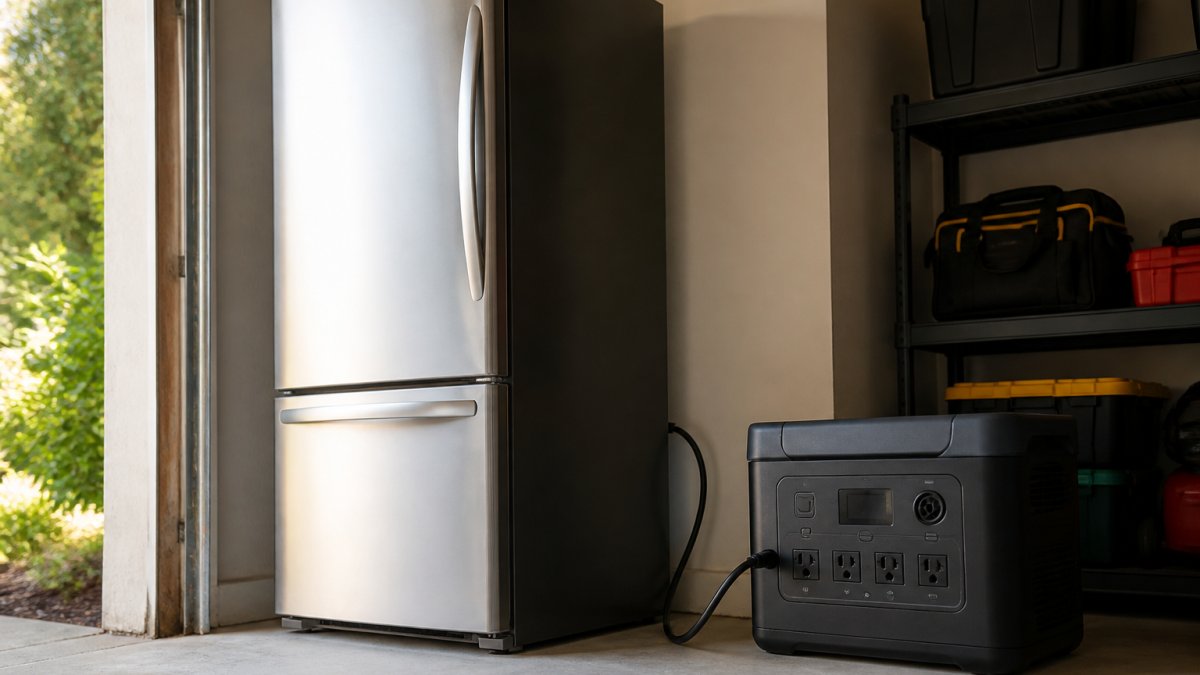
The question "can you run a refrigerator on a portable power station" has a simple answer: yes, but only if the unit's inverter and battery are sized for your fridge's starting watts and daily energy use.
This guide from Generators of Nashville by Evolution Electric breaks down the math. We install backup power systems across Middle Tennessee.
Below, we'll show you exactly how to size a station, estimate runtime, and keep food safe when the grid goes down.
The 4 numbers that decide everything are running watts, startup surge, daily watt-hours, and usable battery capacity. Get those right and the rest is simple.
Refrigerator Starting Watts: Why Surge Power Matters
Refrigerator starting watts are the brief burst of power the compressor needs to spin up. This is the number that catches people out. A fridge might run on 150 watts but demand 1,200 watts or more for a split second at startup.
Here is the sequence:
- The thermostat calls for cooling.
- The compressor motor starts from a dead stop.
- Inrush current spikes for under a second.
- The motor settles to its running watts.
If your station's inverter cannot cover that peak, it shuts down. Your fridge never cools. Most guides skip this part, and it is the single most common reason a setup fails.
How to Find Your Refrigerator's Running and Surge Ratings
Check the appliance label inside the fridge or on the back panel. It lists amps and volts. Multiply amps by volts to get watts.
If the label only shows amps, use this: amps x 120 volts = watts. A fridge rated at 1.5 amps draws about 180 running watts.
For surge, a practical rule is to plan for 3 to 5 times the running watts.
What Size Power Station to Run a Refrigerator
The right portable power station for refrigerator backup depends on your fridge type and how long you need it to run. Match the station's continuous output to your running watts, then confirm its peak output covers the surge.
Use this table to sort your fridge into a rough size band:
| Fridge Type | Typical Running Watts | Surge to Plan For | Station Size to Target |
|---|---|---|---|
| 12-volt or compact fridge | 40-80 | 200-400 | Small (500Wh class) |
| Standard compact fridge | 100-200 | 400-800 | Mid (1,000Wh class) |
| Full-size refrigerator | 150-400 | 1,200-1,800 | Large (2,000Wh+) |
Two specs matter most: continuous output and peak output. Continuous output must exceed running watts with room to spare. Peak output must clear the startup surge.
How Long Will a Power Station Run a Refrigerator?
How long will a power station run a refrigerator comes down to one formula: usable watt-hours divided by the fridge's average hourly draw. A fridge does not run nonstop.
Most guides stop at that sentence. The problem is that "average hourly draw" hides three variables that decide whether your real runtime is 20 hours or 40: the duty cycle, inverter conversion losses, and the station's usable capacity.
The Runtime Formula, With Every Assumption Shown
Runtime (hours) = (Station usable Wh × Inverter efficiency) ÷ (Fridge running watts × Duty cycle)
- Station usable Wh, the energy you can actually draw, not the headline capacity. Many stations reserve 5-15% at the top and bottom to protect the battery, so a "1,000Wh" unit may deliver 850-950Wh. Check the manual for the usable figure.
- Inverter efficiency, converting DC battery power to 120V AC wastes energy as heat. A common range is 80-90% for portable stations. Use 0.85 if the spec sheet is silent.
- Fridge running watts, the steady draw while the compressor is on, from the label or a meter.
Worked Example 1: Full-Size Fridge, 1,000Wh Station
Assume a full-size fridge drawing 150 running watts, a 33% duty cycle, and a 1,000Wh station with 900Wh usable at 85% inverter efficiency.
- Effective energy: 900Wh × 0.85 = 765Wh
- Average hourly draw: 150W × 0.33 = ~50W
- Runtime: 765Wh ÷ 50W = ~15 hours
That is a single overnight run, not a multi-day solution.
Worked Example 2: Same Fridge, 2,000Wh Station
- Effective energy: 1,800Wh usable × 0.85 = 1,530Wh
- Average hourly draw: still ~50W
- Runtime: 1,530Wh ÷ 50W = ~30 hours
Doubling the battery roughly doubles runtime, because the fridge load is unchanged.
Worked Example 3: Hot Garage Changes Everything
Raise the duty cycle to 50% and keep the 2,000Wh station:
- Average hourly draw: 150W × 0.50 = 75W
- Runtime: 1,530Wh ÷ 75W = ~20 hours
Same hardware, 10 fewer hours, purely from ambient temperature. This is why a garage fridge in summer is the hardest case to size for.
Take our 60-second quiz for a free quote today! →
Quick Reference: Runtime by Station Size
Using the 150W / 33% duty cycle fridge above and 85% inverter efficiency:
| Station Usable Wh | Effective Wh | Estimated Runtime |
|---|---|---|
| 500 | 425 | ~8.5 hours |
| 1,000 | 850 | ~17 hours |
| 2,000 | 1,700 | ~34 hours |
| 3,000 | 2,550 | ~51 hours |
Treat these as planning estimates, not guarantees. A 12-volt compressor fridge drawing 45 watts at a 40% duty cycle would run far longer on the same station, while a frost-free full-size unit in a hot garage would run shorter.
Extending Runtime Past One Battery
- Add a second battery if the maker supports expansion, this is the cleanest way to add hours.
- Solar recharge during daylight can offset part of the daily draw, but panel output depends on sun, angle, and shading, so plan solar as a supplement, not a guarantee.
- Pre-cool the fridge before the outage and keep the door shut to lower the duty cycle.
Choosing the Right Portable Power Station for Refrigerator Backup
Pick a station by matching three specs to your fridge: continuous output, peak output, and usable battery capacity. Skip the marketing wattage and read the spec sheet.
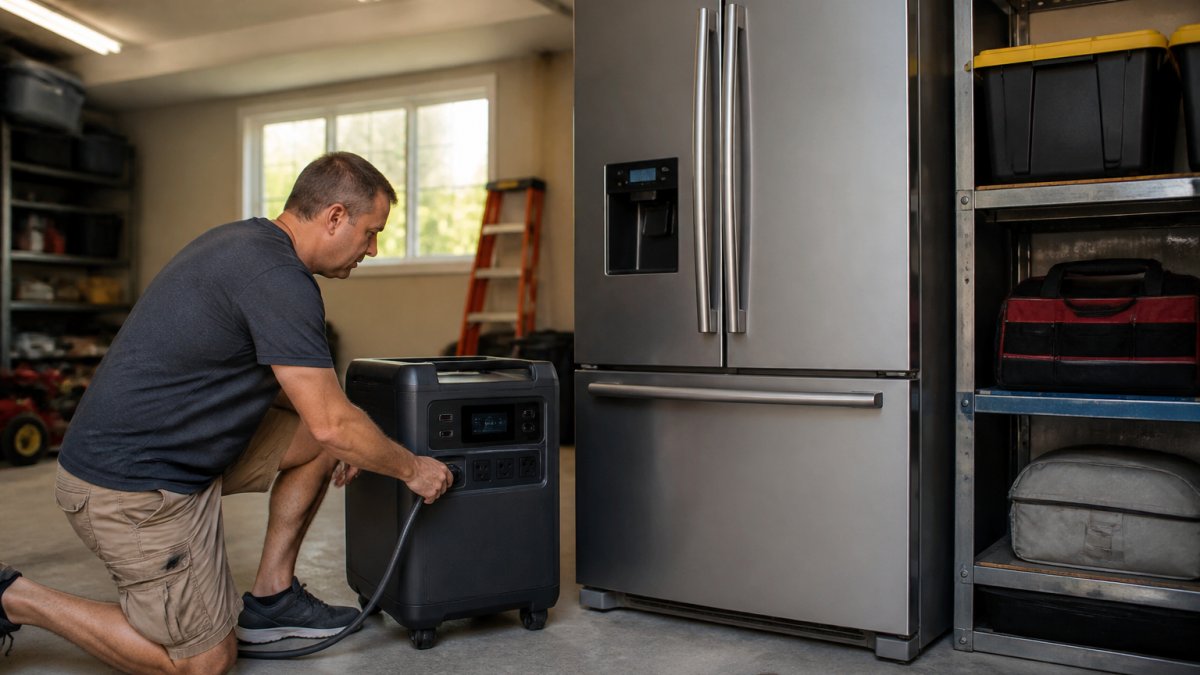
The brands we install, EcoFlow, Anker SOLIX, and Jackery, publish continuous and peak ratings. Compare those, not the box claims. A station with a high peak but a low continuous rating will still struggle.
Battery Chemistry, Usable Capacity, and Long-Term Degradation
Lithium iron phosphate (LiFePO4) batteries last longer than older lithium-ion packs. They hold up over thousands of charge cycles and handle heat better. That matters in a garage during a Tennessee summer.
Usable capacity is not the same as total capacity. Some stations only let you draw 80-90% before they shut off. Plan around the usable number, not the headline one.
Measuring Your Refrigerator's Real Energy Use
The most accurate way to size a station is to measure your own fridge. A plug-in energy meter costs little and removes all guesswork.
Plug the fridge into the meter for 24 hours. It records total watt-hours and peak watts.
- Daily Wh tells you runtime.
- Peak watts tells you inverter size.
- Duty cycle tells you how hard the fridge works.
This is the step most people skip. It is also the step that saves you from buying the wrong station.
Safe Food Storage During an Outage
A closed refrigerator keeps food cold for about 4 hours. A full freezer holds its temperature for roughly 48 hours if you leave the door shut.
Follow these rules:
- Keep the door closed as much as possible.
- Group food together to hold cold.
- Add ice or frozen water bottles if the outage stretches on.
Food held above 40°F for more than 2 hours should be thrown out. When in doubt, toss it. A generator or battery backup pays for itself the first time it saves a full fridge of groceries.
Electrical Compatibility and Safe Operation
Match your station's output to your fridge's plug and voltage. Most home fridges run on standard 120-volt AC outlets, which portable stations provide. But "it plugs in" is not the same as "it is safe to run." These are the details that separate a setup that works from one that damages the fridge or the station.
Pure Sine Wave Output Is Not Optional
Refrigerators use a compressor motor and often a control board. Motors and electronics run best on a smooth, pure sine wave AC signal. Some inexpensive stations output a modified sine wave, a stepped approximation that can cause the compressor to run hotter, buzz, or fail to start, and can stress or damage the control board over time.
- Check the spec sheet for "pure sine wave" output. If it does not say pure sine wave, assume it is not.
- A fridge that hums loudly, runs warm, or trips the station on startup is a sign of a waveform mismatch.
Voltage, Frequency, and Plug Compatibility
- Confirm the station's AC outlet is rated for 120V at 60Hz, the standard for appliances here.
- Confirm the outlet's continuous wattage rating exceeds your fridge's running watts, and its surge rating clears the startup spike.
- Use the fridge's own cord whenever possible. If you must use an extension cord, choose a heavy-gauge, short cord rated for the fridge's running amps, and keep it fully uncoiled so it does not overheat.
Grounding and GFCI
Portable stations are generally designed as standalone power sources and are not bonded to your home's grounding system. That is fine for plugging an appliance directly into the station. It is not fine to backfeed the station into household wiring.
Ventilation and Placement
- Keep the station in a dry, well-ventilated spot, off the floor, away from water and damp concrete.
- Do not block the station's cooling vents; it sheds heat while inverting.
- Keep it out of direct sun and away from the fridge's own hot condenser coils, which raise ambient temperature and shorten runtime.
What Not to Do
- Do not daisy-chain power strips or stations to multiply output unless the maker explicitly supports it; this can overload one inverter and void the warranty.
- Do not run a fridge and a high-draw appliance like a space heater or microwave on the same small station at once.
- Do not ignore a station that shuts down repeatedly on startup, that is a surge-capacity signal, not a fluke.
For whole-home protection, a portable station is a stopgap. A professionally installed system with a proper transfer switch keeps the fridge, internet, and heat running together and isolates your circuits from the grid. Our licensed electricians have served Middle Tennessee since 2014, and we size every system to the actual load, not a guess.
Frequently Asked Questions
Is there a power station that can run a refrigerator?
Yes. Any portable power station with a continuous AC output higher than your refrigerator's running watts and a surge rating above its startup watts can run it. Most full-size refrigerators draw 100 to 250 running watts but need 800 to 1,200 watts for a second or two at compressor startup. A unit rated for at least 1,500 continuous watts with a 3,000-watt surge covers nearly all household refrigerators and leaves headroom for other small loads.
What size power station do I need to run a refrigerator?
Size for both power and energy. For power, pick a station whose continuous output exceeds your fridge's running watts and whose surge rating beats its startup watts. For energy, multiply the fridge's running watts by the hours per day the compressor actually runs, not 24. A typical full-size fridge averages 1 to 2 kWh per day, so a 1,000 to 2,000 Wh station usually covers 12 to 24 hours.
Can a 600-watt power station run a refrigerator?
Sometimes, but only smaller units. A 600-watt station can handle a compact or 12-volt refrigerator that draws under 100 running watts and surges below the station's peak rating. It will not start most full-size compressors, which pull 800 to 1,200 watts at startup. Check the appliance label and the station's surge spec before relying on it for a full-size fridge.
How long will a portable power station run a refrigerator?
Divide the station's usable watt-hours by the refrigerator's average hourly draw. A fridge that uses 1.5 kWh per day averages about 62 watts per hour. A 1,500 Wh station with 85% inverter efficiency delivers roughly 1,275 usable watt-hours, which works out to about 20 hours. Real runtime drops with warm ambient temperatures, frequent door openings, and an undercharged or aging battery.
When the grid goes down, a fridge full of spoiled food is a costly reminder that guesswork does not cut it. Generators of Nashville by Evolution Electric takes the math off your plate. Our licensed electricians install Generac generators, solar arrays, and home battery systems from EcoFlow, Anker SOLIX, and Jackery, all sized to your real load. Take our 60-second quiz for a free, personalized quote and keep your home powered through the next outage.