 how-to
How Long Does a Home Battery Last During an Outage?
Table of Contents
- What Determines How Long a Home Battery Lasts During an Outage
- How to Calculate Battery Backup Time
- How Long Will a 10 kWh Battery Last?
- Appliances to Run During a Power Outage
- How to Extend Home Battery Life During an Outage
- Solar Panels and Recharging During an Outage
- Conclusion: Planning for Reliable Backup Power
- Frequently Asked Questions
Last Updated: October 8, 2026
What Determines How Long a Home Battery Lasts During an Outage
The answer to how long a home battery lasts during an outage comes down to one simple idea: usable energy divided by your actual power draw. A battery does not run for a fixed number of hours.
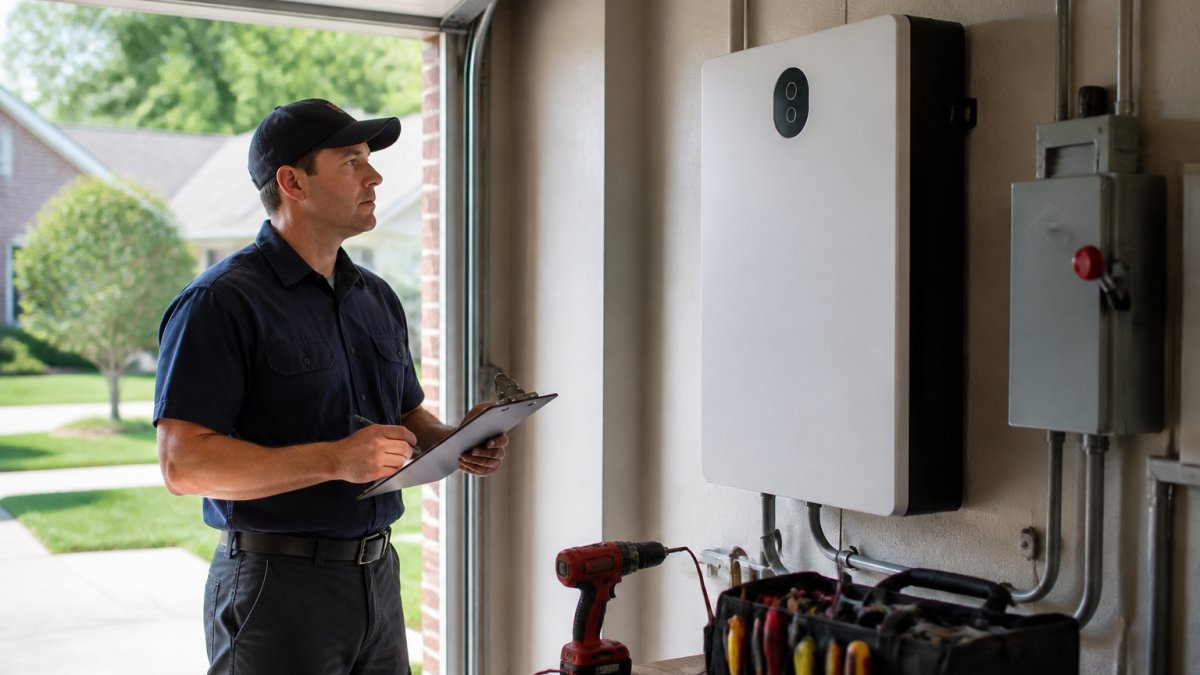
At Generators of Nashville by Evolution Electric, we have installed backup systems across Middle Tennessee since 2014. The battery is rarely the limiting factor. The loads running in the house are.
Three things decide your runtime:
- Battery capacity, how much energy the unit can store
- Depth of discharge, how much of that capacity you can safely use
- Inverter limits, how much power the system can push out at once
Get those three right and you can predict runtime before the storm hits. Get them wrong and you will be guessing in the dark.
Battery Capacity and Usable Capacity
Battery capacity is the total amount of energy a battery can store, measured in kilowatt-hours (kWh). Usable capacity is the portion you can actually draw without damaging the battery.
A 10 kWh battery is not a 10 kWh battery in practice. Most manufacturers set a depth of discharge limit, often around 80 to 90 percent, to protect the cells.
That gap matters. A 10 percent loss on a small system is an hour of runtime you thought you had.
Depth of Discharge and Battery Chemistry
Depth of discharge (DoD) is the percentage of a battery's capacity that has been used. A 90 percent DoD means you can drain 90 percent of the stored energy before recharging.
Chemistry sets the rules here:
- Lithium-ion and LiFePO4 batteries handle deep discharge well, often 80 to 100 percent DoD
- Lead-acid batteries should not go below 50 percent DoD without shortening their life
LiFePO4 is the common choice for home backup today. It runs cooler, lasts longer, and tolerates deeper cycles than lead-acid.
Inverter Limits and Power Output
A battery can hold plenty of energy and still fail to run your home if the inverter cannot push enough power at once. The inverter converts stored DC power into the AC power your appliances use.
Inverters are rated in kilowatts (kW), not kWh. That rating is your ceiling for how many appliances can run at the same time.
How to Calculate Battery Backup Time
Backup time equals usable battery capacity divided by your average load in kilowatts. That is the whole formula. The hard part is figuring out your real load, not the number on the spec sheet.
Here is how we walk homeowners through it.
Step-by-Step Formula with a Worked Example
Step 1: Find usable capacity. Take the rated kWh and multiply by the depth of discharge.
Step 2: Estimate your average load. Add up the watts of everything you plan to run, then divide by 1,000 to get kW.
Step 3: Divide usable capacity by load.
| Step | Calculation | Example |
|---|---|---|
| Rated capacity | Spec sheet | 10 kWh |
| Depth of discharge | 90% | 9 kWh usable |
| Average load | 1.5 kW | 1,500 watts running |
| Backup time | 9 ÷ 1.5 | 6 hours |
That is a transparent result you can trust. Change any input and the runtime changes with it.
How Long Will a 10 kWh Battery Last?
A 10 kWh battery's runtime depends entirely on what you keep running.
Real-World Scenarios: Essential Loads vs. Whole-Home Backup
Essential loads are the circuits you cannot live without: refrigerator, internet router, a few lights, phone chargers, and a sump pump. This is a light draw, often under 1 kW. A 10 kWh battery can carry this for most of a day.
Whole-home backup means everything runs as normal, including HVAC, electric water heater, and oven. That load can hit 5 kW or more. The same battery empties in a few hours.
| Scenario | Typical Load | Runtime on 10 kWh |
|---|---|---|
| Essential loads only | 0.8 kW | ~11 hours |
| Essential plus heating/cooling | 2.5 kW | ~3.5 hours |
| Whole-home, heavy use | 5 kW | ~1.8 hours |
The lesson is simple. Load management buys you hours. Turn off what you do not need and the same battery runs longer.
Appliances to Run During a Power Outage
Start with the appliances that protect your home and health, then add comfort items only if capacity allows.
Take our 60-second quiz for a free quote today! →
Most motor-driven appliances pull a brief surge of two to three times their running wattage when they kick on.
Here are typical running and startup figures for common backup loads. Treat these as planning estimates, not spec-sheet numbers, since efficiency ratings vary by model and age.
| Appliance | Typical Running Watts | Typical Startup Surge |
|---|---|---|
| Refrigerator (energy-efficient) | 100-200 | 300-600 |
| Chest freezer | 100-200 | 300-600 |
| Sump pump (1/3 hp) | 800-1,000 | 1,600-3,000 |
| Well pump (1/2 hp) | 900-1,200 | 2,000-3,500 |
| Furnace blower (gas) | 300-500 | 700-1,200 |
| Central AC (3-ton) | 3,000-4,000 | 9,000-12,000 |
| Window AC (10,000 BTU) | 900-1,200 | 2,000-3,000 |
| LED lights (per bulb) | 8-12 | 8-12 |
| Internet router and modem | 10-20 | 10-20 |
| Laptop charger | 45-90 | 45-90 |
| Phone charger | 5-10 | 5-10 |
| Microwave | 1,000-1,500 | 1,000-1,500 |
| Electric range (one burner) | 1,200-1,500 | 1,200-1,500 |
| Clothes dryer (electric) | 3,000-5,000 | 3,000-5,000 |
| Space heater | 1,500 | 1,500 |
Prioritize in this order:
- Refrigerator and freezer, keeps food safe
- Internet router and modem, critical for remote work
- Sump pump, prevents basement flooding
- A few LED lights, safety and visibility
- Phone and laptop chargers, communication
- Medical equipment, any device a household member depends on
Skip the electric oven, clothes dryer, and space heaters during an outage. They drain a battery fast. A microwave used for a few minutes is fine.
For heating and cooling, set the thermostat conservatively. HVAC is the single biggest load in most homes. Running a central AC on a battery is possible, but it eats runtime quickly and often requires a larger inverter than a typical essential-loads setup. A window unit or a single mini-split is a far more battery-friendly way to stay comfortable. Managing these climate control systems effectively prevents unnecessary strain on your electrical reserves, though you may eventually need to consult Brass Tacks Plumbing Heating & Cooling to restore full furnace functionality once the grid stabilizes.
ENERGY STAR appliance energy use reference
How to Extend Home Battery Life During an Outage
You can stretch runtime with a few habits that cost nothing. Load management is the difference between a battery that dies at midnight and one that lasts until the sun comes up.
- Turn off lights and devices in empty rooms
- Unplug chargers and electronics you are not using
- Run large appliances one at a time, never together
- Lower the thermostat a few degrees in winter, raise it in summer
- Use LED bulbs, which draw a fraction of the power of incandescent
- Delay dishwashing and laundry until power returns
Battery lifespan matters too. A battery that has cycled for years holds less usable capacity than a new one. Plan for gradual degradation, and do not expect year-ten performance to match year one.
Solar Panels and Recharging During an Outage
Solar panels can recharge a home battery during an outage, but only if the system is designed to do it. This is the part most guides skip, and it is where the real difference between a one-night battery and a multi-day one lives.
Why Grid-Tied Solar Shuts Off
A standard grid-tied solar setup shuts down within milliseconds when the grid goes down. This is called anti-islanding, and it is a safety requirement under UL 1741, the standard that governs grid-interactive inverters. The reason is simple: line workers repairing downed wires cannot have your panels feeding power back onto a line they believe is dead.
So the panels are not broken. They are doing exactly what they were built to do. To keep solar running when the grid is down, you need one of three setups:
- A hybrid inverter with a backup circuit. The inverter disconnects from the grid and forms its own microgrid to power backed-up loads and charge the battery.
- A dedicated battery inverter (AC-coupled). The battery system creates its own grid signal, and the solar inverter follows it.
- A DC-coupled system. Solar feeds the battery directly through a charge controller, then the battery inverter powers the home.
If your system was installed as a plain grid-tied array with no battery, it will not produce power during an outage no matter how sunny it is.
How Much Solar Actually Recharges the Battery
Recharge rate depends on array size, sun angle, weather, and the inverter's charge limit.
That means the battery charges fastest between about 10 a.m. and 3 p.m. and barely at all in early morning or late afternoon. On a cloudy day, output can drop to 10-25 percent of the clear-sky figure. On a snowy day, panels covered by snow may produce almost nothing until they clear.
What This Means for Outage Runtime
When solar is present and configured for backup:
- Panels recharge the battery during daylight
- The battery carries the home overnight
- Runtime extends across multiple days, not just hours, if loads stay modest and weather cooperates
On a sunny day, a solar-plus-battery system can run essential loads almost indefinitely. On a cloudy winter day, expect limited charging and plan to conserve. The answer to "how long will it last" with solar is a range, not a number, because the sun is a variable input.
Conclusion: Planning for Reliable Backup Power
Every home has a different load profile, and that is why a one-size-fits-all answer to backup runtime does not exist. The right system depends on your appliances, your priorities, and how long you need to ride out an outage.
If you want a system sized to your actual home instead of a generic estimate, Generators of Nashville by Evolution Electric can help.
Take our 60-second quiz for a free quote and find out exactly how long your home can stay powered.
Frequently Asked Questions
How long can a home battery power a house during an outage?
A home battery's runtime depends on its usable capacity and your household load. If you run heavy appliances like an HVAC system or electric water heater, a battery's runtime will be significantly shorter than if you power only essential loads. Calculate your average load in watts and divide usable capacity by that number to estimate hours of power.
What appliances can a home battery run during a power outage?
A home battery can run essential appliances such as a refrigerator, freezer, lights, internet router, phone chargers, and a sump pump. With a larger battery or whole-home backup system, you can also power a well pump, furnace fan, or a small window AC unit. High-draw appliances like central air conditioning or electric ranges require significantly more capacity and may need load management or a generator.
Will a home battery recharge during an outage?
Yes, if your home battery is paired with solar panels and the sun is shining, it can recharge during a power outage. This extends your backup runtime indefinitely as long as solar production exceeds your energy usage. Without solar, a battery cannot recharge from the grid during an outage, so its runtime is limited to its initial charge. Some systems also support generator recharging.
How do you calculate how long a home battery will last?
To calculate battery backup time, divide the battery's usable capacity in kilowatt-hours (kWh) by your average power consumption in kilowatts (kW). For example, a 10 kWh battery with 90% depth of discharge gives 9 kWh usable. If your essential loads draw 0.5 kW on average, runtime is 9 kWh ÷ 0.5 kW = 18 hours. Always account for inverter efficiency and battery age, which can reduce usable capacity.