 ultimate-guide
Residential Solar Panel Battery Installation Guide
Table of Contents
- Can You Add a Battery to Your Existing Solar Panel System?
- AC-Coupled vs DC-Coupled Solar Batteries: Which Configuration Fits Your Home?
- Solar Battery Installation Cost: What Drives the Final Price?
- Choosing from the Best Home Energy Storage Systems of 2026
- The Installation Process: From Permit to Power-On
- Battery Warranties, Lifespan, and Degradation Realities
- DIY vs. Professional Solar Battery Installation
- Conclusion: Is Home Battery Storage the Right Move?
- Frequently Asked Questions
Last Updated: September 5, 2026
If you already have solar panels, the question isn't whether you can add a battery, but whether your current system is wired for it. Residential solar panel battery installation is the fastest-growing upgrade in home energy, and for most homeowners with a grid-tied array, retrofitting a battery is entirely feasible without replacing your existing panels. At Generators of Nashville by Evolution Electric, our licensed electricians have handled these retrofits since 2014, and the single biggest variable is almost always the same: inverter compatibility.
A solar battery stores excess photovoltaic energy during the day and discharges it at night or during an outage. The key distinction for retrofits is whether your existing inverter can communicate with a new battery. If you have a string inverter without battery-ready ports, you will likely need an AC-coupled solution, which works with virtually any existing solar array. If you are building a new system or replacing an inverter anyway, a DC-coupled or hybrid inverter setup is often more efficient. We'll walk through the decision, the cost drivers, and the installation timeline so you know exactly what to expect before you commit.
Can You Add a Battery to Your Existing Solar Panel System?
Yes, in nearly all cases you can add a battery to an existing solar array, provided your inverter and electrical panel are compatible. The retrofit process is straightforward for most homes, but the answer depends on three factors: your inverter type, your available wall space, and your utility's interconnection rules.
Most homes with solar installed in the last decade use a string inverter or microinverters. Both can work with a battery retrofit, but the wiring path differs. A battery with its own inverter, known as an AC-coupled battery, connects on the AC side of your solar system. This is the simplest retrofit path because it does not require touching your existing solar wiring.
Before scheduling any work, check your utility's net metering policy. Under net metering, you may already be banking credits for excess daytime generation (energy.gov). Adding a battery shifts your strategy from selling power back to the grid to storing it for your own use, which changes how your utility bills you. Your installer should handle the interconnection application, but you should confirm the policy in your area first.
AC-Coupled vs DC-Coupled Solar Batteries: Which Configuration Fits Your Home?
AC-coupled systems connect a battery to your home through its own inverter, while DC-coupled systems feed battery power through your existing solar inverter. This single distinction drives most of the compatibility, efficiency, and cost decisions in residential solar panel battery installation.
AC-coupled is the default choice for retrofits. Because the battery has its own inverter, it does not care what brand or type of solar inverter you already have. The trade-off is efficiency: power converts from DC in the panels to AC in your home, then back to DC for the battery, then back to AC when you use it. Each conversion loses a small amount of energy, so round-trip efficiency typically lands a few points lower than DC-coupled.
DC-coupled systems run the battery on the DC side of your solar inverter, which means one conversion instead of two. This is more efficient, often by 3 to 5 points of round-trip efficiency, but it requires a hybrid inverter that supports both solar input and battery charging. If your current inverter is not hybrid, a DC-coupled retrofit means replacing it, which adds significant cost.
| Configuration | Best For | Efficiency | Retrofit Complexity |
|---|---|---|---|
| AC-Coupled | Adding battery to existing solar | Lower (multiple conversions) | Low, no inverter change |
| DC-Coupled | New solar + battery installs | Higher (single conversion) | High, requires hybrid inverter |
For most homeowners adding a battery to an existing system, AC-coupled is the pragmatic choice. It is simpler, less expensive to install, and works with any solar array. DC-coupled makes sense when you are already replacing your inverter or building a new system from scratch.
Solar Battery Installation Cost: What Drives the Final Price?
The cost of a solar battery installation is driven primarily by equipment, labor, and electrical upgrades, and it varies widely based on your home's specific conditions. Because pricing depends on your system size, panel capacity, and local labor rates, the most reliable way to get an accurate figure is a site evaluation from a licensed installer.
Several factors push the final number up or down:
- Battery capacity and chemistry: Larger kilowatt-hour ratings cost more. Lithium iron phosphate batteries are the current standard for home storage due to their cycle life and safety profile (energy.gov).
- Electrical panel upgrades: Older homes often need a panel upgrade or a new subpanel to handle the additional amperage from a battery and its inverter.
- Permit and inspection fees: Your municipality charges for the electrical permit and final inspection, which are mandatory for grid-tied systems.
- Installation labor: Mounting a battery that can weigh over 100 kilograms, running conduit, and making utility connections takes a full day or more for a licensed crew.
A common mistake is comparing only battery prices online without accounting for these installation variables. The battery unit itself is a fraction of the total project. You are paying for a licensed electrician to integrate the battery safely with your home's electrical system and your utility's grid connection.
Choosing from the Best Home Energy Storage Systems of 2026
The best home energy storage systems of 2026 share a few non-negotiable traits: lithium iron phosphate chemistry, a strong battery management system, and integrated monitoring software. Brands like EcoFlow, Anker SOLIX, and Jackery lead the market, and each offers distinct advantages depending on your priorities.
EcoFlow's home backup units are known for their modular capacity and fast recharge rates. Anker SOLIX emphasizes long cycle life and strong app integration. Jackery has built its reputation on reliability and portable options that scale up to whole-home backup. When evaluating any of these, focus on three specifications rather than marketing claims:
- Usable capacity: The kilowatt-hour rating you can actually draw, not the raw cell capacity.
- Depth of discharge: How much of the battery you can use before it stops delivering power. Most quality units allow 80 to 100 percent.
- Round-trip efficiency: How much energy you get back versus what you put in. Higher is better for both cost and environmental impact.
For most Middle Tennessee homeowners, the right system balances outage coverage with daily self-consumption. A battery that covers your refrigerator, internet, and a few circuits during an outage may be sufficient, while running central air conditioning during a multi-day event requires a much larger bank. This is where a professional load assessment matters. At Generators of Nashville by Evolution Electric, we pair each homeowner with a system sized to their actual needs, not a one-size-fits-all package.
The Installation Process: From Permit to Power-On
A professional residential solar panel battery installation typically takes one to two days on site, preceded by a permit application that can take one to three weeks depending on your local jurisdiction. The process follows a predictable sequence that protects both your home and your utility connection.
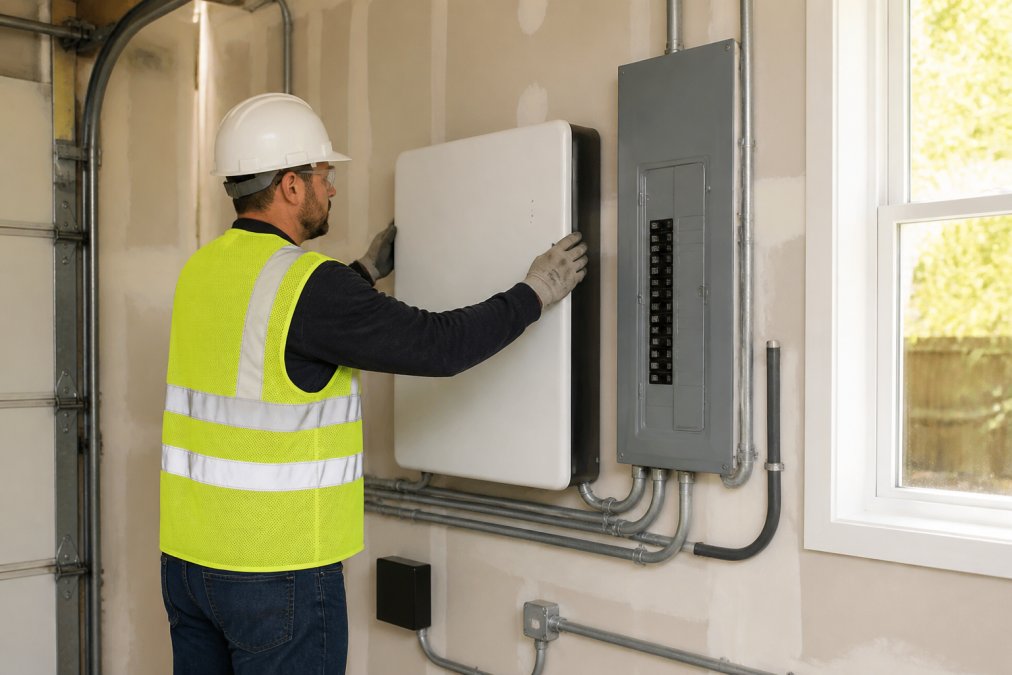
Step 1: Site assessment and load calculation. Your installer evaluates your electrical panel capacity, measures available wall space, and calculates which circuits the battery should back up. This determines the system size and whether you need a panel upgrade. EV charger installation.
Step 2: Permit application. Your installer files for the electrical permit with your local building department. The application includes system diagrams, equipment specifications, and your utility interconnection request. This step cannot be skipped for grid-tied systems.
Take our 60-second quiz for a free quote today! →
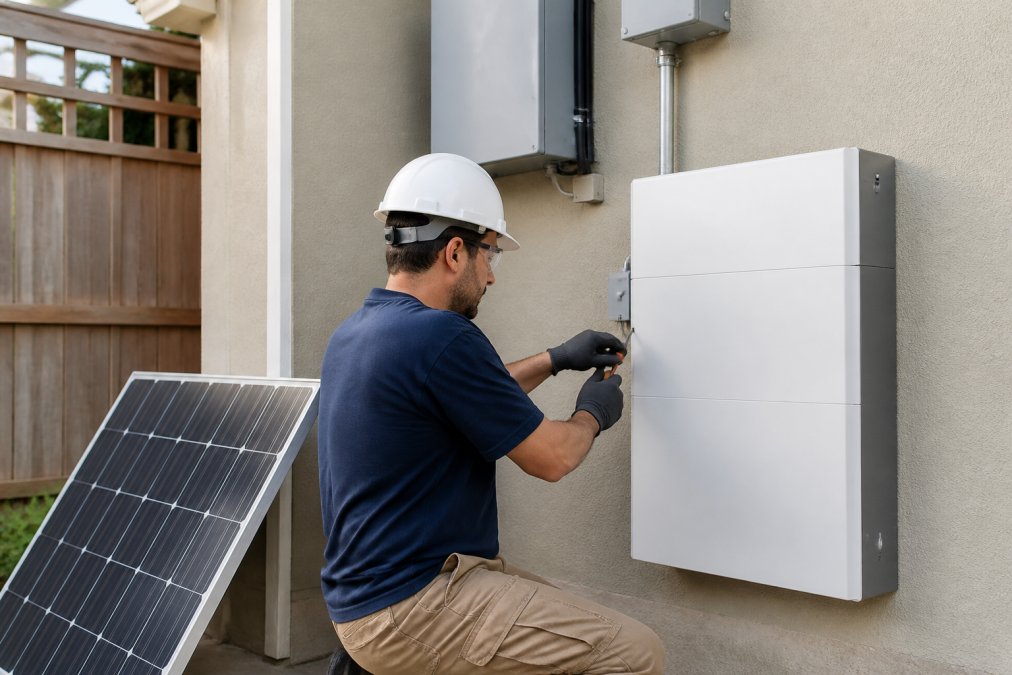
Step 3: Physical installation. The crew mounts the battery unit, installs the inverter or backup interface, runs conduit, and makes the connections to your electrical panel. This is the bulk of the on-site labor.
Step 4: Utility interconnection. After the physical install, your utility may require an inspection or meter swap before you can export power. This is often the longest waiting period in the process.
Step 5: Final inspection and power-on. Your local inspector verifies the work meets electrical code, then your installer energizes the system and walks you through the monitoring software.
Battery Warranties, Lifespan, and Degradation Realities
A home battery is a long-term investment, but it does not last forever. Most manufacturers warrant their batteries for 10 years or a specific number of cycles, whichever comes first, and the battery's capacity degrades gradually over that period. Understanding how degradation works prevents disappointment later.
Lithium iron phosphate chemistry, which dominates the best home energy storage systems, offers the longest cycle life of any consumer battery chemistry. A typical warranty guarantees around 70 percent capacity retention after 10 years. That means a 10 kilowatt-hour battery may only deliver 7 kilowatt-hours of usable energy by the end of its warranty period. This is normal, not a defect.
The battery management system, or BMS, plays a critical role in slowing degradation. It regulates temperature, prevents overcharging, and balances cells to extend life. You cannot control the BMS directly, but you can avoid habits that stress the battery, such as regularly discharging it to zero. Most manufacturers recommend keeping the state of charge between 20 and 90 percent for daily cycling, reserving the full range for outage events (batteryuniversity.com).
Before you buy, read the warranty's fine print on throughput and environmental conditions. Some warranties require installation by a licensed professional to remain valid, and most exclude damage from improper installation. This is one more reason professional installation is not just a convenience, it protects your warranty coverage.
DIY vs. Professional Solar Battery Installation
DIY installation of a home battery is only viable for small, portable power stations that plug into an outlet, not for whole-home backup systems wired into your electrical panel. The distinction is critical: if the battery connects to your home's wiring rather than a standard wall outlet, professional installation is required for safety, code compliance, and warranty validity.
Attempting a DIY installation of a grid-tied battery system creates several serious problems. The electrical permit and inspection process exists to verify safe installation, and most utilities will not approve an interconnection without it. Your homeowner's insurance may also deny a claim if damage stems from unpermitted electrical work. And as noted, most battery warranties explicitly require professional installation.
Professional installation by a licensed electrician costs more upfront but delivers measurable value. A licensed crew handles the permit, coordinates with your utility, ensures code compliance, and verifies the system operates safely before they leave. The installation typically takes one to two days, and the work is backed by the installer's liability and expertise.
For homeowners in Middle Tennessee weighing this decision, the practical answer is almost always professional installation for any system intended to power your home during an outage. The complexity of the electrical work, the permit requirements, and the warranty stipulations make DIY a false economy for whole-home systems.
Conclusion: Is Home Battery Storage the Right Move?
Adding a battery to your solar array makes sense if you experience frequent outages, want to maximize your solar investment through self-consumption, or value energy independence over grid reliance. The decision comes down to your outage frequency, your utility's rate structure, and whether your current inverter supports an efficient retrofit. A battery is not a small purchase, but for homes that lose power several times a year, the convenience of seamless backup power often justifies the investment.
The team at Generators of Nashville by Evolution Electric has installed home battery systems across Middle Tennessee since 2014, pairing brands like EcoFlow, Anker SOLIX, and Jackery with the right electrical setup for each home. Our licensed electricians handle the permit, the utility coordination, and the installation from start to finish, so your system is ready when the next storm hits. Take our 60-second quiz today to receive a free, personalized quote for your whole-home backup system.
Frequently Asked Questions
Is it worth installing a battery with my solar panels?
For most homeowners, a solar battery is worth it when backup power during outages is a priority or when your utility has time-of-use rates that make load shifting valuable. It's less about pure financial return and more about energy independence and resilience. If you work from home, rely on medical devices, or live in an area with frequent storms, the peace of mind often outweighs the cost. A professional assessment can clarify how a battery would perform for your specific usage patterns.
Can I add a battery to my existing solar panel system?
Yes, in most cases you can retrofit a battery to your current setup. The key is determining whether your existing inverter is battery-ready or if you need an AC-coupled solution. AC coupling is the most common retrofit path because it works with virtually any standard inverter by adding a separate battery inverter. Your installer will verify system compatibility, check your panel's output, and ensure your electrical panel can handle the additional load before proceeding.
How long do residential solar batteries typically last?
Most modern lithium iron phosphate batteries are warrantied for 10 to 12 years or a specific throughput, often around 6,000 to 10,000 cycles. In practice, that translates to 15 to 20 years of daily use before capacity degrades to 70% or 80% of the original rating. Battery management systems help prolong life by protecting against overcharging and extreme temperatures. Check the warranty terms carefully, as they define what degradation level triggers a replacement.
Do I need a permit for a residential solar battery installation?
Yes, virtually all jurisdictions require an electrical permit for adding a battery system to your home. This ensures the installation meets the National Electrical Code and local fire safety standards, particularly regarding battery placement and ventilation. A licensed installer handles the permitting process and coordinates the required inspections. This protects your homeowner's insurance coverage and is essential for maintaining eligibility for federal tax credits and utility interconnection agreements.
Frequently Asked Questions
Q: Is it worth installing a battery with my solar panels?
A: For most homeowners, a solar battery is worth it when backup power during outages is a priority or when your utility has time-of-use rates that make load shifting valuable. It's less about pure financial return and more about energy independence and resilience. If you work from home, rely on medical devices, or live in an area with frequent storms, the peace of mind often outweighs the cost. A professional assessment can clarify how a battery would perform for your specific usage patterns.
Q: Can I add a battery to my existing solar panel system?
A: Yes, in most cases you can retrofit a battery to your current setup. The key is determining whether your existing inverter is battery-ready or if you need an AC-coupled solution. AC coupling is the most common retrofit path because it works with virtually any standard inverter by adding a separate battery inverter. Your installer will verify system compatibility, check your panel's output, and ensure your electrical panel can handle the additional load before proceeding.
Q: How long do residential solar batteries typically last?
A: Most modern lithium iron phosphate batteries are warrantied for 10 to 12 years or a specific throughput, often around 6,000 to 10,000 cycles. In practice, that translates to 15 to 20 years of daily use before capacity degrades to 70% or 80% of the original rating. Battery management systems help prolong life by protecting against overcharging and extreme temperatures. Check the warranty terms carefully, as they define what degradation level triggers a replacement.
Q: Do I need a permit for a residential solar battery installation?
A: Yes, virtually all jurisdictions require an electrical permit for adding a battery system to your home. This ensures the installation meets the National Electrical Code and local fire safety standards, particularly regarding battery placement and ventilation. A licensed installer handles the permitting process and coordinates the required inspections. This protects your homeowner's insurance coverage and is essential for maintaining eligibility for federal tax credits and utility interconnection agreements.