 comparison
Standby vs Portable Generator for Home: 2026 Guide
Table of Contents
- Standby vs Portable Generator: Core Differences
- Standby Generator vs Portable Generator Cost
- How to Size a Generator for a House
- Portable Generator Safety and Carbon Monoxide Risks
- Standby Generator Installation and Transfer Switch Setup
- Automatic Operation vs Manual Setup
- Which Generator Is Right for Your Home?
- Frequently Asked Questions
Last Updated: October 10, 2026
Standby vs Portable Generator: Core Differences
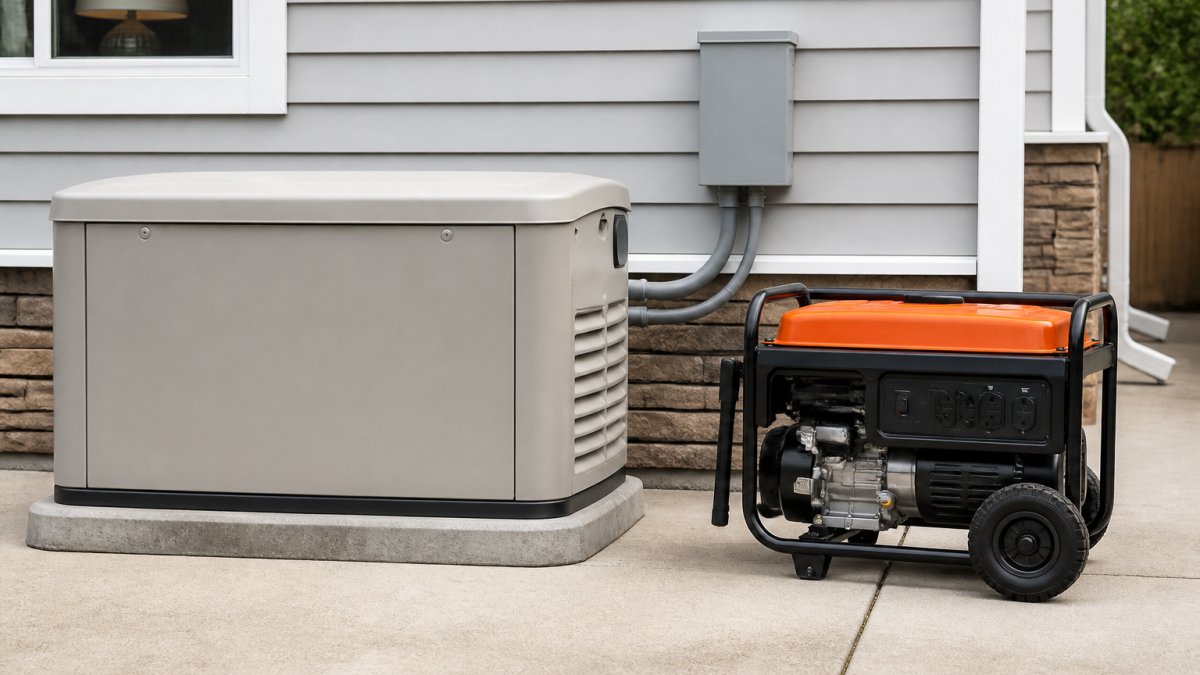
A standby generator is permanently installed, connects directly to your home's electrical panel, and activates automatically when power fails. A portable generator is a movable unit that requires manual setup and fuel delivery each time you need backup power. The choice between a standby vs portable generator for home use comes down to convenience, upfront cost, and how much of your home you want to protect during an outage.
Standby generators run on natural gas or propane piped directly to your home and operate indefinitely. Portable generators run on gasoline or propane stored in tanks you refill manually. Standby units sit outside year-round; portable units live in a garage until needed, then require manual setup with fuel and extension cords.
Standby Generator vs Portable Generator Cost
The upfront cost differs dramatically, but true cost extends beyond the sticker price. Both initial purchase and long-term ownership expenses determine the best choice.
Portable Generator Costs
Portable generators range from $1,000 to $6,000. A mid-range dual-fuel unit (7,000-9,000 watts) costs $2,500-$4,000 with no installation fees. However, ongoing expenses include:
- Fuel storage and purchase: Gasoline averages $3-$4 per gallon; a portable generator consuming 2-3 gallons per hour costs $6-$12 hourly. A 48-hour outage exceeds $300 in fuel. Propane units consume 1-1.5 gallons per hour at full load.
- Fuel stabilizer and storage containers: Gasoline degrades in storage; budget $10-$20 yearly for stabilizer and $50-$100 for approved containers.
- Maintenance: Oil changes, spark plugs, and tune-ups cost $100-$300 annually.
- Replacement: Portable generators last 5-10 years; budget for replacement every 7-10 years.
10-year portable generator cost: Purchase ($3,000) + fuel ($1,200-$2,400) + maintenance ($1,000-$2,000) + replacement ($2,500) = $7,700-$10,900.
Standby Generator Costs
Standby generators cost more upfront but eliminate recurring fuel expenses. A residential unit (15,000-25,000 watts) costs $3,000-$6,000; installation is the major cost driver:
- Professional installation: Electrician labor, transfer switch, permits, and site prep run $3,000-$8,000 (natural gas is usually cheaper than propane).
- Permits and inspections: Electrical permits ($200-$500) and building permits ($100-$300) are required; inspections are mandatory.
- Fuel supply upgrades: Propane tank installation ($500-$2,000) may be required if natural gas is unavailable.
- Maintenance: Annual load testing, fuel inspection, and oil changes cost $150-$300 yearly.
- Replacement: Standby generators last 15-20 years; replacement costs $8,000-$15,000 installed.
10-year standby generator cost: Unit ($4,500) + installation ($5,500) + permits ($400) + fuel supply ($1,000) + maintenance ($2,000) = $13,400-$15,000 (no fuel cost).
Cost Comparison by Scenario
Frequent outages (4+ per year, 12+ hours each) favor standby generators; rare outages (1-2 per year, under 6 hours) favor portable. Remote properties without natural gas benefit from propane standby systems despite higher upfront cost. Renters or those with HOA restrictions may only have portable options.
How to Size a Generator for a House
Correct sizing prevents buying equipment that can't power what you need. Understand starting watts versus running watts, then calculate your actual simultaneous load.
Starting Watts vs Running Watts
Starting watts (peak or surge watts) reflect the initial power spike when motors start; running watts are sustained power once operating.
Central AC needs 5,000 starting watts but 3,500 running watts. Well pumps demand 4,000 starting watts but run at 1,500 watts.
Step-by-Step Load Calculation
-
List all appliances and circuits you want to protect. Separate them into "must-have" (refrigerator, heating, water heater, medical equipment) and "nice-to-have" (AC, pool pump, electric range).
-
Find the running wattage for each appliance. Check the nameplate on the equipment or the owner's manual. If unavailable, use the table below as a reference.
-
Identify the largest motor-driven load. This is usually your central AC, well pump, or pool pump. Note both its starting and running watts.
-
Calculate your simultaneous load. Add the running watts of every appliance you want to run at the same time. For example:
- Refrigerator: 800 watts
- Heating system: 3,500 watts
- Water heater: 4,500 watts
- Home office (computer, router, lights): 800 watts
- Total running load: 9,600 watts
-
Add the largest motor's starting watts. If your heating system has a 3,500-watt starting spike, your generator must handle 9,600 (running) + 3,500 (spike) = 13,100 watts at startup.
-
Round up by 10-15%. Generators lose efficiency under full load and in cold weather. A 13,100-watt requirement should be met with a 15,000-watt generator to ensure reliable operation.
Common Appliance Wattage Reference
| Appliance | Starting Watts | Running Watts | Notes |
|---|---|---|---|
| Refrigerator | 2,200 | 600-800 | Cycles on/off; include running watts in simultaneous load |
| Central AC (3-ton) | 5,000 | 3,500 | Largest load in most homes; rarely runs with other major motors |
| Heating system (forced air) | 3,500 | 3,000 | Oil or gas furnace with electric blower |
| Electric water heater | 5,500 | 4,500 | Continuous draw when heating; consider if you want hot water during outage |
| Well pump (1 HP) | 4,000 | 1,500 | Critical for rural homes; starts frequently |
| Pool pump (1.5 HP) | 3,600 | 2,200 | Optional load; can be skipped during outages |
| Microwave | 1,200 | 1,000 | High surge; avoid running simultaneously with large motors |
| Electric range | 12,000 | 5,000+ | Rarely run on generator; use propane grill or camp stove instead |
| Home office (computer, monitor, router) | 1,000 | 500-800 | Essential for remote workers |
| Lighting (essential circuits, LED) | 500 | 300-500 | Modern LED bulbs use far less than incandescent |
| Sump pump (0.5 HP) | 1,600 | 800 | Critical in flood-prone areas |
| Garage door opener | 1,200 | 400 | Starts frequently; include in simultaneous load |
Sizing for Partial vs Whole-Home Coverage
Take our 60-second quiz for a free quote today! →
Most homeowners don't need whole-home coverage. Partial-home sizing is more cost-effective:
- Essential circuits only (10,000-12,000 watts): Refrigerator, heating, water heater, lighting, home office.
- Essential circuits + AC (15,000-18,000 watts): Adds air conditioning; don't run AC and electric water heater simultaneously.
- Whole-home coverage (20,000-30,000 watts): Runs almost any appliance but requires larger generator and higher fuel consumption.
Real-World Example: A Work-From-Home Household
A homeowner in a moderate climate works from home and wants to maintain productivity during outages:
- Refrigerator: 800 watts
- Heating system: 3,500 watts (winter) or 0 watts (summer)
- Home office: 800 watts
- Lighting: 400 watts
- Water heater: 4,500 watts (optional; can skip during short outages)
Winter simultaneous load: 800 + 3,500 + 800 + 400 = 5,500 running watts. Add the heating system's 3,500-watt starting spike = 9,000 watts required.
Summer simultaneous load: 800 + 800 + 400 = 2,000 running watts. If AC is added (5,000 starting watts), total = 7,000 watts required.
Avoiding Undersizing
Undersizing is the most common mistake. A generator rated for 10,000 watts cannot reliably start a 5,000-watt AC unit if other loads are present.
Portable Generator Safety and Carbon Monoxide Risks
Portable generators pose serious carbon monoxide hazards. Never run them indoors, in garages, basements, crawlspaces, or partially enclosed spaces (the CDC). Position at least 20 feet from windows, doors, and vents; point exhaust away from occupied spaces. Wind can redirect exhaust toward your home.
Portable generators create fire hazards. Keep away from flammable materials. Cool before refueling; gasoline on hot engines ignites instantly. Store fuel in approved containers in well-ventilated areas, never indoors.
Standby generators vent exhaust safely through a chimney or wall-mounted vent pipe installed by a licensed electrician. The system is engineered to prevent carbon monoxide from entering your home. This safety advantage alone justifies the higher cost for many families.
Standby Generator Installation and Transfer Switch Setup
Standby generator installation requires a licensed electrician and a transfer switch, a critical safety device that prevents backfeeding electricity into the grid when the generator is running. Backfeeding can electrocute utility workers and damage equipment.
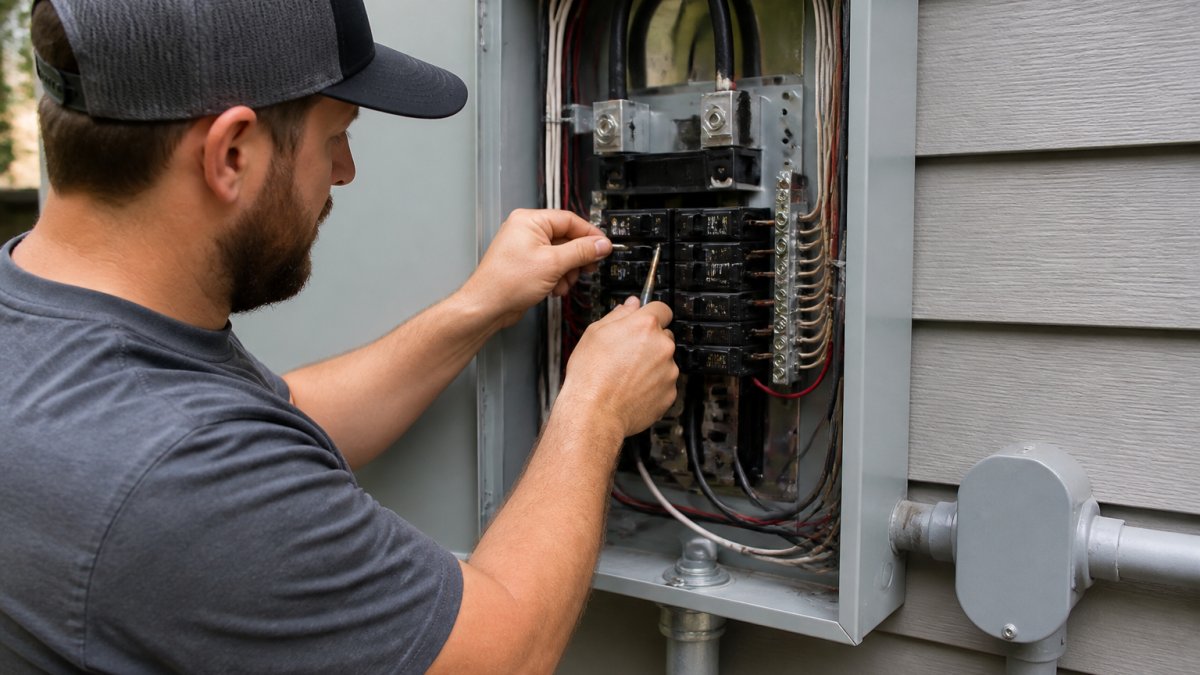
Installation involves positioning the generator unit (usually outside on a concrete pad), running fuel lines from your natural gas or propane supply, running electrical conduit from the generator to your electrical panel, and installing the transfer switch inside the panel.
The process typically takes 1-2 days for a professional crew. Your electrician will determine whether your home's fuel supply is adequate or if upgrades are needed.
Automatic Operation vs Manual Setup
Standby generators activate automatically within 10-30 seconds; the transfer switch detects the outage and seamlessly switches power. When grid power returns, the generator shuts down automatically.
Portable generators require manual intervention: notice the outage, locate the unit, check fuel, add fuel if needed, wheel it to position, connect cords, and start the engine. In bad weather or emergencies, this is stressful and time-consuming. Automatic operation is standby's biggest advantage; manual operation is portable's biggest limitation.
Which Generator Is Right for Your Home?
Choose a standby vs portable generator for home based on your outage frequency, budget, and how much downtime you can tolerate.
Portable generators suit homeowners in areas with rare, brief outages, those on tight budgets, renters who can't install permanent equipment, and people comfortable with manual operation and fuel management. They're also useful as a backup to a standby system or for temporary power needs outside the home.
Middle Tennessee experiences seasonal weather events that can knock out power for hours or days. If you work from home or depend on power for medical equipment, a standby generator eliminates the stress of outages.
The real question isn't which option is "better", it's which aligns with your situation, budget, and tolerance for manual work during emergencies.
Frequently Asked Questions
What's the main difference between a standby generator and a portable generator?
A standby generator is permanently installed outside your home and automatically activates during a power outage, while a portable generator is a movable unit you manually set up and operate. Standby generators connect to your home's fuel supply and electrical panel through a transfer switch, providing whole-home coverage with minimal effort. Portable generators require manual placement, fuel refilling, and cord connections to individual appliances or circuits. Standby generators cost significantly more upfront but offer convenience and complete backup power, whereas portable generators are cheaper initially but demand active management during outages.
Can a portable generator power an entire house?
Most portable generators cannot reliably power an entire house. A typical home uses 5,000-10,000 watts continuously during normal operation. While some high-output portable models can reach high peak watts, they cannot sustain that output indefinitely and cannot power large appliances like central AC, electric heating, or water heaters simultaneously. Portable generators work best for essential appliances only: refrigerators, lights, computers, and medical equipment. For whole-home coverage, a standby generator sized to your household's actual load is the only reliable option.
How much does it cost to install a standby generator with a transfer switch?
Standby generator costs depend on system size, fuel type, installation complexity, and local permits. The generator unit itself, professional installation labor, electrical panel upgrades, transfer switch hardware, concrete pad, gas line or propane tank installation, and permits all factor into the total investment. For accurate pricing tailored to your home's needs and Middle Tennessee electrical codes, contact Generators of Nashville by Evolution Electric for a free, personalized quote using our 60-second assessment quiz. Professional installation by licensed electricians ensures safety, code compliance, and reliable operation when you need it most.
Is it safe to run a portable generator inside or near my house?
No. Portable generators produce carbon monoxide, a colorless, odorless, deadly gas that builds up quickly in enclosed or partially enclosed spaces. Never run a portable generator indoors, in a garage, basement, attic, or even near open windows and doors. Place your generator at least 20 feet away from your home, doors, windows, and vents, in a dry, sheltered location. Ensure proper ventilation around the unit. Carbon monoxide poisoning can occur within minutes and is often fatal. Standby generators are safer because they are permanently installed outdoors with proper exhaust venting, eliminating this risk entirely.
Power outages disrupt work, spoil food, and leave families uncomfortable and unsafe. Generators of Nashville by Evolution Electric has installed hundreds of backup power systems for Middle Tennessee homeowners since 2014. Our licensed electricians handle the entire process, sizing, permitting, installation, and transfer switch setup, so your home stays powered when the grid fails. Take our 60-second quiz today to receive a free, personalized quote for your whole-home backup system.