 how-to
How Long Will 10kWh Power a Home? Real Runtime Guide
Table of Contents
- How Long Will 10kWh Power a Home? The Short Answer
- Average Daily Home Energy Consumption in the U.S.
- Essential vs Non-Essential Loads for Home Batteries
- How to Calculate Battery Backup Runtime for Your Home
- What a 10kWh Battery Can Actually Run (and What It Can't)
- Best Battery Backup for Home Office and Remote Work
- What Shortens 10kWh Runtime: Seasonal Loads, Standby Draw, and Smart Load Management
- Frequently Asked Questions
Last Updated: September 29, 2026
How Long Will 10kWh Power a Home? The Short Answer
10kWh power runs a typical home's essential loads for about 10 to 12 hours, or a whole house for roughly 4 to 6 hours. This guide from Generators of Nashville by Evolution Electric breaks down the real runtime math.
kWh vs kW: Capacity and Power Are Not the Same
A kilowatt-hour (kWh) measures energy storage, how much total work a battery can do over time. A kilowatt (kW) measures power, how fast that energy gets used. Think of kWh as your fuel tank and kW as how fast the engine burns through it.
Average Daily Home Energy Consumption in the U.S.
The average household energy consumption in the United States sits around 30kWh per day, according to U.S. Energy Information Administration residential energy data. That works out to roughly 1.25kWh every hour.
| Usage Scenario | Average Draw | 10kWh Runtime |
|---|---|---|
| Whole house, normal habits | 1.25 kW | ~8 hours |
| Essentials only | 0.5 kW | ~20 hours |
| Heavy loads (AC, oven) | 3-4 kW | ~2-3 hours |
Essential vs Non-Essential Loads for Home Batteries
Splitting your home into essential and non-essential loads is the fastest way to extend battery runtime. Essentials keep your home safe and livable; non-essentials are conveniences you can live without for a few hours.
Essential loads usually include:
- Refrigerator and freezer
- A few lights and outlets
- Internet router and modem
- Phone chargers
- Sump pump or well pump
- Medical equipment
Non-essential loads typically include:
- Central air conditioning
- Electric oven and range
- Clothes dryer
- Electric water heater
- Pool pump
How to Calculate Battery Backup Runtime for Your Home
Calculating battery backup runtime takes more than dividing capacity by load. You must account for usable capacity, inverter losses, surge wattage, and how appliances cycle on and off.
- List every appliance you want on backup power
- Find each item's running wattage on its label or manual
- Note which appliances have a surge (startup) wattage, motors and compressors typically spike 2 to 3 times their running watts for a few seconds
- Add the running wattages together for your total continuous load
- Identify the largest single surge wattage your system must handle at once
- Divide usable battery capacity in watt-hours by your continuous load
- Subtract inverter losses and standby draw
Account for Depth of Discharge and Inverter Efficiency
Two factors shrink that 20-hour estimate. Depth of discharge (DoD) is the share of capacity you can safely use, many lithium-ion batteries allow 80% to 90% DoD, so a 10kWh unit might give 8 to 9kWh of usable energy. Inverter efficiency also matters: converting stored DC power to AC loses energy, and most modern inverters run at 90% to 95% efficiency.
The Losses Most Guides Skip: Inverter Idle Draw and Standby Consumption
Even a high-efficiency inverter pulls 20 to 50 watts just to stay on and ready, idle draw or tare loss. Over a 20-hour outage, a 30-watt idle draw consumes 600 watt-hours, or 6% of your 10kWh battery, before you power a single appliance. The battery management system (BMS) and monitoring hardware add another 5 to 15 watts.
A Worked Example With Real Appliance Wattages
Here is a realistic essential-loads scenario for a 10kWh battery with 90% DoD (9,000 usable watt-hours) and a 92% efficient inverter (8,280 watt-hours after conversion):
| Appliance | Running Watts | Hours/Day | Daily Wh |
|---|---|---|---|
| Refrigerator (cycles ~1/3 of the time) | 150 | 8 effective | 1,200 |
| LED lights (10 bulbs at 12W) | 120 | 5 | 600 |
| Router and modem | 20 | 24 | 480 |
| Laptop and phone chargers | 90 | 6 | 540 |
| Box fan | 70 | 8 | 560 |
| TV | 100 | 4 | 400 |
| Inverter idle draw | 30 | 24 | 720 |
| Total | 4,500 Wh |
What a 10kWh Battery Can Actually Run (and What It Can't)
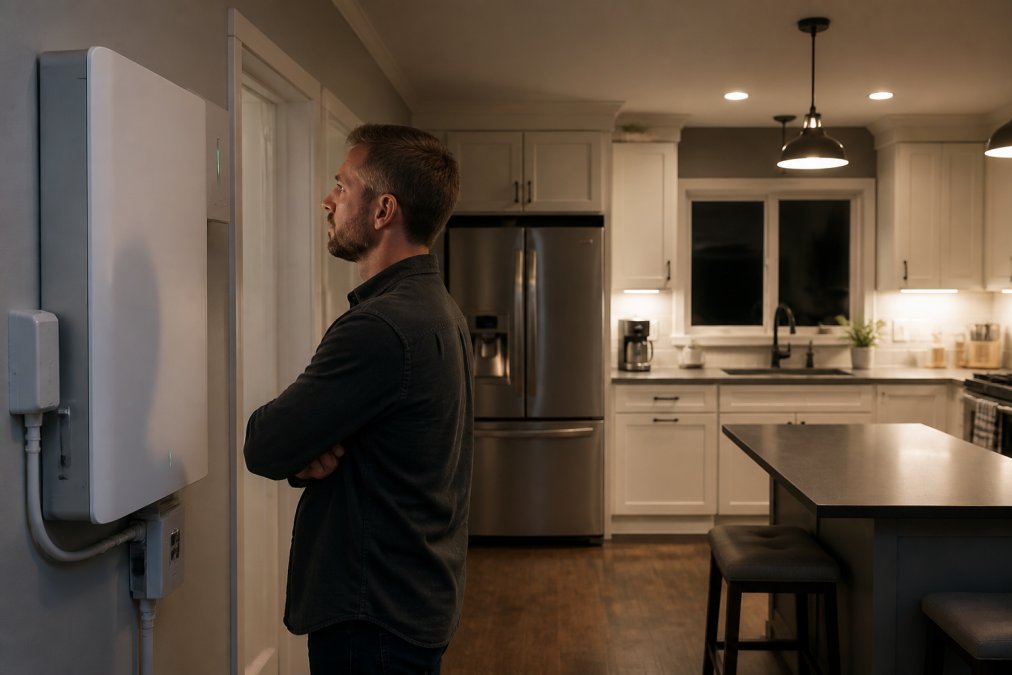
A 10kWh battery comfortably runs a home's essentials for a full day, but it cannot carry central air conditioning and major appliances for long. The line comes down to running watts versus surge watts.
Take our 60-second quiz for a free quote today! →
Run these together and 10kWh holds up well:
- Refrigerator (about 150 watts running, 600 to 800 watts surge on compressor start)
- LED lights (10 to 15 watts each)
- Router and modem (about 20 watts)
- Laptop and phone chargers (under 100 watts)
- A box fan (about 70 watts)
- Television (80 to 150 watts)
High-Draw Appliances: AC, Heat Pumps, and Ovens
High-draw appliances drain a 10kWh battery fast. A central air conditioner pulls 3,000 to 4,000 watts running, with startup surges to 12,000 watts or more. An electric oven draws 2,000 to 5,000 watts, an electric water heater near 4,000, and a heat pump 3,000 to 5,000 depending on outdoor temperature. Run just the AC and you get two to three hours; add the oven and you're under two.
Seasonal Variance: Why a 10kWh Estimate Is Misleading Year-Round
Most guides give one runtime number and call it done, almost always wrong for at least half the year. Seasonal load swings change consumption dramatically: a 10kWh battery that covers 20 hours in spring may only cover 10 in a July heat wave or January cold snap.
| Season | Added Load | Daily Wh Added | Runtime Impact |
|---|---|---|---|
| Spring/Fall | None (mild temps) | 0 | ~44 hours |
| Summer | Window AC (1,200W, 8 hrs) | 9,600 | ~18 hours |
| Summer | Central AC (3,500W, 8 hrs) | 28,000 | ~6 hours |
| Winter | Space heater (1,500W, 10 hrs) | 15,000 | ~12 hours |
| Winter | Heat pump (4,000W, 10 hrs) | 40,000 | ~4 hours |
Smart Load Management: The Fix Most Guides Ignore
Smart load management is the most effective way to stretch a 10kWh battery without buying more capacity. Instead of running everything, you prioritize circuits and shed the rest automatically. Some systems shed non-essential circuits when state of charge drops below a threshold; others stagger big appliances, the water heater only runs above 50%, and the EV charger is disabled during an outage.
- Always on: refrigerator, freezer, medical equipment, internet, a few lights
- On when battery above 50%: TV, laptop charging, microwave
- On when battery above 70%: window AC or space heater (one at a time)
- Never on during outage: central AC, electric oven, clothes dryer, EV charger, pool pump
Homeowners who want to keep essentials running during short outages and are willing to shed high-draw appliances to stretch runtime, not homeowners who expect whole-home backup from a single 10kWh unit.
Best Battery Backup for Home Office and Remote Work
For remote workers, the best battery backup for a home office is a system sized to carry internet, computer, and lighting without interruption, a small load that fits a 10kWh battery perfectly.
A typical home office draws very little:
- Desktop or laptop: 100 to 200 watts
- Monitor: 30 to 50 watts
- Router and modem: about 20 watts
- LED desk lighting: 10 to 20 watts
What Shortens 10kWh Runtime: Seasonal Loads, Standby Draw, and Smart Load Management
Three factors quietly cut runtime: seasonal load swings, standby power draw, and load management. Each is easy to overlook and easy to fix.
Frequently Asked Questions
Is 10kWh enough to run a house during an outage?
It depends on what you keep running. A 10kWh battery can power essential loads like a refrigerator, Wi-Fi router, lights, phone chargers, and a laptop for roughly 20 to 30 hours, accounting for depth of discharge and inverter losses. Whole-home backup with central AC and electric heating will drain it in a few hours. Most homeowners use 10kWh power for critical circuits only, not the entire electrical panel.
How many kWh does an average home use per day?
The U.S. Energy Information Administration reports the average American household uses about 30 kWh per day, though this varies widely by region, home size, and whether heating and cooling are electric. A 2,000 sq ft home with electric heat or central AC can exceed 40 kWh daily in peak summer or winter. Understanding your own average daily home energy consumption is the first step to sizing any battery correctly.
What factors reduce the runtime of a 10kWh battery?
Four factors matter most. Depth of discharge limits how much of the 10kWh you can safely use, often 80 to 90 percent for lithium-ion. Inverter efficiency losses typically consume 5 to 10 percent during conversion. High-draw appliances like AC, heat pumps, and ovens pull power fast. Standby loads, including cable boxes and smart devices, quietly drain capacity around the clock. Seasonal variance and cold temperatures also cut usable capacity in winter.
Does a 10kWh battery provide enough power for a home office?
Yes, comfortably. A typical home office setup, including a computer, two monitors, router, modem, desk lamp, and phone charger, draws roughly 300 to 500 watts. That means a 10kWh battery with 90 percent usable capacity can run a home office for 18 to 30 hours. If you add a space heater or window AC unit, expect runtime to drop sharply. For remote workers in outage-prone areas, this is one of the most practical uses of a 10kWh system.