 blog
blog
Happy Hiller vs Coolray Generator Services: 2026 Comparison
Table of Contents
- Happy Hiller vs Coolray Generator Services: Quick Comparison
- Who Installs Generac in Tennessee (And Why It Matters)
- How to Choose a Backup Power Installer
- Generac vs EcoFlow Home Battery Systems
- Generator Sizing Guide: Matching Power Capacity to Your Home
- Maintenance Plans and Service Contracts: Cost-Benefit Analysis
- Which Generator Service Is Right for Your Home?
- Frequently Asked Questions
Last Updated: September 15, 2026
Happy Hiller vs Coolray Generator Services: Quick Comparison
Choosing between Happy Hiller and Coolray for generator services comes down to a simple distinction: Happy Hiller is a full-service home contractor that added generators to its offering, while Coolray built its reputation on HVAC and plumbing before expanding into standby power. Neither company is a dedicated generator specialist.
That matters more than most homeowners realize. Generator installation involves load calculations, transfer switch wiring, fuel source planning, and permit coordination, all of which sit outside the core trade of a general home services company.
| Factor | Happy Hiller | Coolray |
|---|---|---|
| Primary trade | HVAC, plumbing, electrical, generators | HVAC, plumbing, electrical, generators |
| Generator focus | Secondary service line | Secondary service line |
| Branded equipment | Generac | Generac |
| Service model | Full home services contractor | Full home services contractor |
| Dedicated generator specialization | No | No |
This comparison from Generators of Nashville by Evolution Electric examines what each provider actually offers, where the gaps appear, and what a dedicated generator services provider brings to a whole-home installation.
Who Installs Generac in Tennessee (And Why It Matters)
Generac generators are installed by factory-authorized dealers, licensed electrical contractors, and general home services companies across Tennessee. The distinction between these categories determines who handles your warranty claim, who performs load calculations, and who answers the phone at 2 a.m. during an outage.
Both Happy Hiller and Coolray install Generac units as part of broader home service offerings. That works fine for straightforward replacements. It gets complicated when your installation requires a transfer switch upgrade, a load calculation that accounts for a home office setup, or integration with an existing solar array.
The Generac dealer locator and installer requirements outlines what authorized installation actually involves. Factory authorization means the installer has completed manufacturer training, carries the correct insurance, and can register your warranty without third-party delays.
What most homeowners miss is that authorization is not the same as specialization. A company can be authorized to install Generac units and still complete only a handful of installations per year. Ask how many whole-home standby systems the company installed in the past twelve months. The answer tells you more than any certification badge.
How to Choose a Backup Power Installer
The right backup power installer combines three things: a current electrical license, demonstrated experience with whole-home standby systems, and a maintenance program that outlasts the warranty period. Price matters, but it ranks fourth.
What no ranking article gives you is a way to compare two providers on the same axes. Here is the framework that separates qualified installers from order-takers, and the specific questions that produce comparable answers.
1. Licensing and who actually pulls the permit. Ask whether the electrical license is held by the company or by a subcontractor, and whether the company pulls the installation permit or pushes it to you. In most jurisdictions the permit holder is the party of record if something goes wrong. A company that tells you to pull your own permit is telling you who carries the liability.
2. Installation volume, not certification badges. Ask how many whole-home standby systems the company installed in the past twelve months. A factory-authorized dealer can still complete only a handful per year. Volume correlates with the muscle memory that matters: transfer switch wiring, fuel line sizing, concrete pad prep, and the permit office relationships that shorten approval timelines.
3. Who performs the load calculation, and is it documented. The load calculation is the single most consequential document in the project. Ask who performs it, whether it is a worksheet listing every appliance by name with running watts and starting watts, and whether you receive a copy. If the answer is a square-footage rule of thumb, that is an estimate, not a calculation.
4. Response-time guarantee in writing. This is the metric competitors never publish. Ask what the committed response window is for a no-start during an outage, whether it differs for maintenance-plan customers, and whether the commitment is contractual or aspirational. A provider that will not put a number in writing does not have one.
5. Warranty terms, including labor. Equipment warranty is set by the manufacturer and is identical across dealers. Labor warranty is set by the installer and varies widely. Ask for the labor coverage term in writing, and ask who files the warranty registration, the installer or you.
6. Maintenance program structure. Confirm the plan includes annual service visits with parts and labor, not just a phone number. Ask whether plan customers get priority scheduling during outage events, and how that priority is defined.
7. Fuel source and transfer switch scope. Confirm the quote specifies transfer switch capacity, fuel line sizing, and pad preparation. These are the line items where corners get cut, and they are the line items that determine whether the system works on the first outage.
Take our 60-second quiz for a free quote today! →
A common mistake is choosing on equipment price alone. Two installers can quote the same Generac unit and deliver wildly different results because the installation scope differs. Run both quotes through the seven questions above side by side. The comparison usually makes the decision obvious before you ever discuss price.
Generac vs EcoFlow Home Battery Systems
Generac standby generators and EcoFlow home battery systems solve the same problem through different mechanisms. Generac burns propane or natural gas to produce power indefinitely as long as fuel is available. EcoFlow stores energy in batteries and recharges from the grid or solar panels.
The choice depends on your outage patterns and priorities:
- Extended outages (multi-day): Generac wins because fuel supply outlasts battery capacity
- Short outages (hours): EcoFlow runs silently with no fuel requirement
- Solar integration: EcoFlow pairs directly with existing solar arrays
- Whole-home coverage: Generac handles high-draw appliances like central AC more easily
- Noise and emissions: EcoFlow operates silently with zero exhaust
Many Middle Tennessee homeowners land on a hybrid approach: a Generac standby unit for extended winter ice storms and an EcoFlow battery for short summer outages. That combination covers both scenarios, though it doubles the upfront investment.
For remote workers who need guaranteed uptime for internet and computer equipment, battery systems offer one advantage generators cannot match: instant switchover with no startup delay. A standby generator takes a few seconds to spin up and transfer power. A battery system switches in milliseconds.
Generator Sizing Guide: Matching Power Capacity to Your Home
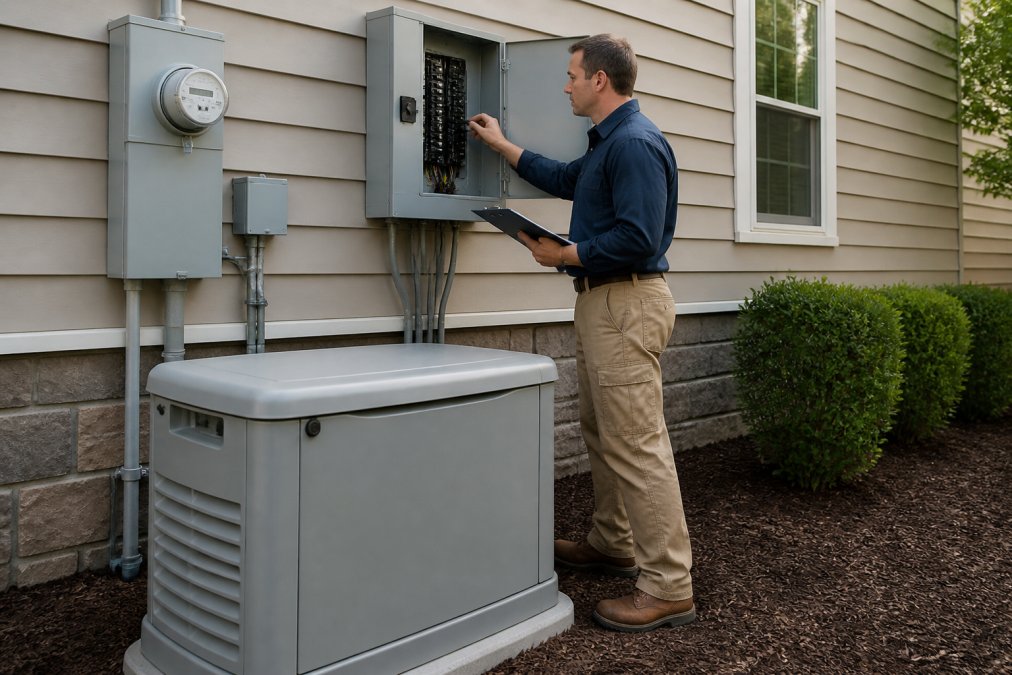
Generator sizing starts with a load calculation, not a square footage estimate. The calculation adds up every appliance and system you want to run during an outage, then applies a starting wattage multiplier for motor-driven equipment.
Three tiers cover most homes:
| Home Type | Typical Capacity | Runs During Outage |
|---|---|---|
| Essential circuits only | 7.5-10 kW | Fridge, lights, internet, sump pump |
| Most appliances | 14-18 kW | Above plus well pump, furnace, microwave |
| Whole home including AC | 22-26 kW | Everything including central air |
A 22 kW unit is the most common choice for homes with central air conditioning. Homes with two AC units, an electric range, or a heat pump often need 26 kW or larger.
The critical number is starting wattage. A central air conditioner that draws 3,500 running watts can pull 12,000 watts at startup (energy.gov). If your load calculation ignores startup draw, your generator will trip its breaker every time the compressor engages.
Maintenance Plans and Service Contracts: Cost-Benefit Analysis
Most generator articles list a plan price and move on.
Here is the framework that makes the decision concrete:
Which Generator Service Is Right for Your Home?
Frequently Asked Questions
Does Happy Hiller install Generac generators in Middle Tennessee?
Happy Hiller offers generator services in the Middle Tennessee area, but availability and specific brand authorizations can vary. If you need Generac installation, confirm the company holds current manufacturer authorization and employs licensed electricians. Generators of Nashville by Evolution Electric has been an authorized Generac installer since 2014, serving homeowners throughout Middle Tennessee with whole-home standby systems.
What is the service area for Coolray generator installations?
Coolray provides generator services across parts of the Southeast, including portions of Tennessee. Coverage can differ by service type, so verify your address falls within their current generator installation zone before scheduling. For Middle Tennessee homeowners who want a local provider focused specifically on backup power, Generators of Nashville by Evolution Electric serves the region with licensed electricians and a free 60-second quote process.
How do I choose the right backup power installer for my home?
Start by verifying the installer holds a current electrical license and manufacturer authorization for the brand you want. Ask whether they handle permits, load calculations, and transfer switch installation in-house or subcontract those steps. Request a written scope of work before signing anything. A provider that performs an on-site assessment and explains your power capacity needs in plain terms is usually a better fit than one that quotes over the phone without seeing your panel.
Do generator installation companies offer ongoing maintenance plans?
Many do, but the scope varies. A solid preventative maintenance program covers annual oil and filter changes, radiator inspection, battery testing, and transfer switch checks. Ask whether the plan includes priority scheduling during storm season and what the service contract actually covers versus what costs extra. Generators of Nashville by Evolution Electric provides professional installation for the systems it offers.