 how-to
Grid-Tied Solar in an Outage: How It Works and What to Do
Last Updated: November 9, 2026
Quick Summary
A standard grid-tied solar system shuts off during a power outage, so its panels cannot power your home even in sunshine. Grid-tied solar outages leave homes dark unless backup equipment such as a battery, transfer switch, or backup-capable inverter is installed. The shutdown protects utility workers from electrical backfeed.
- Standard grid-tied systems shut down during outages by design to protect lineworkers.
- Anti-islanding rules require inverters to disconnect within a fraction of a second.
- Panels still produce power in sunlight, but the inverter stays off until the grid is stable.
- Backup needs a battery, transfer switch, and backup-capable inverter or gateway.
- Check your inverter model and confirm which circuits sit on the backup load panel.
Table of Contents
- Do Solar Panels Work During a Power Outage?
- Why Grid-Tied Solar Shuts Off When the Grid Fails
- How to Use Grid-Tied Solar During a Power Outage
- Solar Panels With Battery Backup During Power Outages
- How Long Can a Home Battery Power a House During an Outage?
- Planning Realistic Backup Capacity and Essential Loads
- Booking a Backup Power Assessment for Your Home
- Frequently Asked Questions
Most grid-tied solar systems shut off during a power outage, even on a bright, sunny day, and that surprises many homeowners who expected their panels to keep the lights on. Understanding why grid-tied solar outages happen is the first step toward avoiding them. The answer depends on how your system is wired. Here is how grid-tied solar behaves when the grid goes down, and what you can do about it.
Do Solar Panels Work During a Power Outage?
A standard grid-tied solar system does not power your home during an outage, so grid-tied solar outages leave homes dark unless backup equipment is added.
Grid-tied solar is a system where your panels feed electricity into the utility grid and draw from it when needed. It needs the grid to work. When the grid fails, the system shuts down by design.
Why Grid-Tied Solar Shuts Off When the Grid Fails
Grid-tied inverters are built to match the utility's voltage and frequency. When the grid goes down, the inverter loses its reference signal and stops exporting power. This protects the people working on the lines.
Anti-Islanding Protection and Utility Worker Safety
Islanding happens when a home keeps sending power into lines that utility crews assume are dead. A lineworker could be seriously hurt or killed. To prevent this, inverters must detect an outage and disconnect within a fraction of a second. This rule is part of the electrical code and utility interconnection standards that installers follow.
Many homeowners ask why their solar stops even though the sun is shining. Anti-islanding protection is the reason.
What Happens to the Panels and Inverter
The panels keep generating during daylight. The inverter stays idle, waiting for the grid to return. Once utility voltage comes back, the inverter typically waits a short period before reconnecting. This delay gives the grid time to stabilize.
- Panels: still produce power when sunlight is present
- Inverter: stays off until the grid is confirmed stable
- House: runs only on utility power, or nothing at all
How to Use Grid-Tied Solar During a Power Outage
A grid-tied system can keep your home powered during an outage, but only if it was built with backup-capable equipment. The difference between a system that goes dark and one that keeps the refrigerator running comes down to four components: a backup-capable inverter, a battery (or another stored-energy source), a transfer mechanism that isolates your home from the utility, and a set of backed-up circuits.
Step 1: Identify your inverter type
Check the model number on the inverter nameplate or in your installation paperwork. Standard string inverters and most microinverters are grid-following only, so they shut down until utility power returns. Backup-capable equipment falls into two families:
- Hybrid inverters combine a solar inverter and a battery charger/discharger in one unit and can form their own reference voltage during an outage.
- Backup gateways or load panels work alongside a standard inverter and a battery to disconnect from the grid and energize a subset of circuits.
If your paperwork shows only a grid-tied inverter with no battery and no backup gateway, your system has no outage capability as installed. That is the most common configuration and it is not a defect, it is a design choice.
Step 2: Confirm the backup circuit
Backup-capable systems almost never power the whole house. They feed a dedicated backup load panel, sometimes called a critical-loads panel. Ask your installer which circuits are on it. A typical configuration covers the refrigerator, a few lighting circuits, the internet router, a sump pump, and a medical device circuit.
Step 3: Understand the outage sequence
When the grid fails, a backup-capable system runs through a fixed sequence:
- Detection. The inverter or gateway senses loss of utility voltage and frequency within a fraction of a second.
- Isolation. A transfer switch, automatic in most modern backup systems, opens the connection between your home and the utility service, creating a safe island.
- Backup-mode startup. The inverter or gateway establishes its own voltage and frequency reference, then draws from the battery to energize the backup panel.
- Solar recharge. If the sun is up, the inverter redirects solar production to the backed-up loads and any surplus to recharging the battery.
- Reconnection. When utility voltage returns and stays stable for a short qualifying period, the transfer switch closes and the system returns to grid-tied operation.
Watch out: a manual transfer switch requires you to throw it yourself during an outage, and if you are not home or do not know the procedure, the backup will not engage, confirm with your installer whether your switch is automatic or manual.
Step 4: Plan and test your loads
Know which appliances are on the backup panel and how much power each draws.
Watch out: never connect a portable generator to your home's wiring without a listed transfer switch, backfeeding onto utility lines can injure or kill lineworkers and is prohibited by electrical codes and utility interconnection rules.
The steps below summarise what to check and do when a grid-tied system faces an outage.
| Step | What to do | Time or frequency |
|---|---|---|
| Identify your inverter type | Check the model number on the nameplate or paperwork | Once, before an outage |
| Confirm the backup circuit | Ask which circuits sit on the backup load panel | Once, during installation review |
| Understand the outage sequence | Know the detect, isolate, startup, recharge, reconnect steps | Within a fraction of a second for detection |
| Plan and test your loads | Know appliance draws and simulate an outage with your installer | Test with your installer |
Solar Panels With Battery Backup During Power Outages
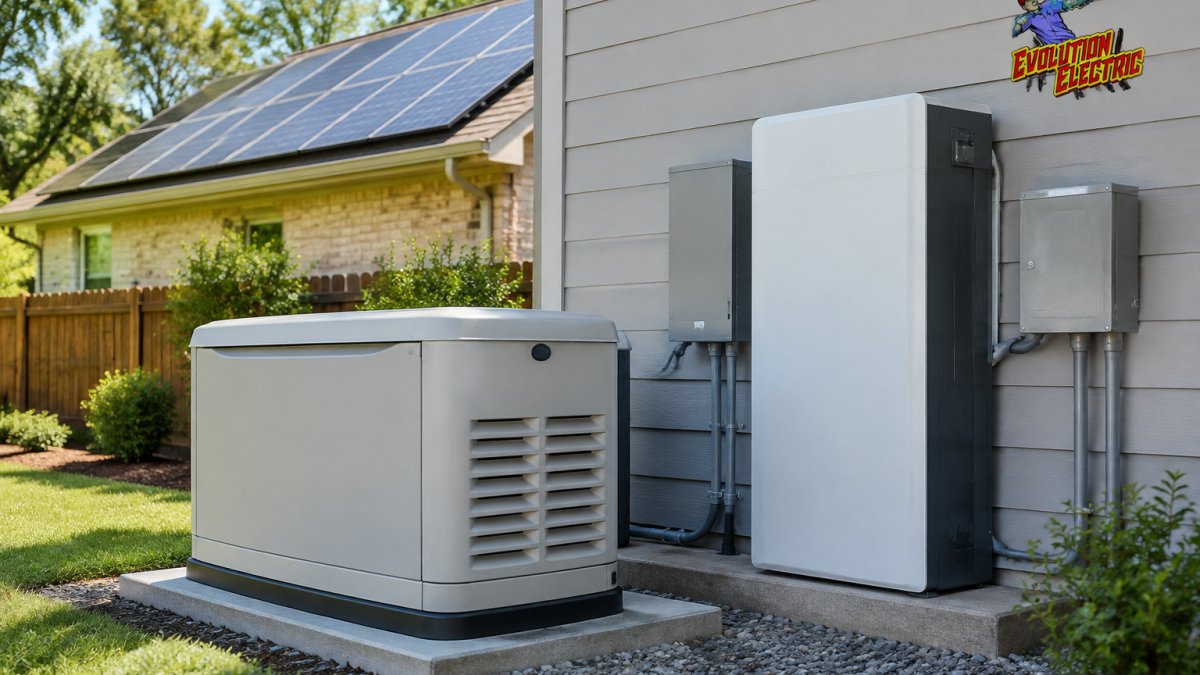
A battery stores solar energy and releases it when the grid fails. With the right inverter and transfer setup, the battery can power selected circuits through the night and into the next day.
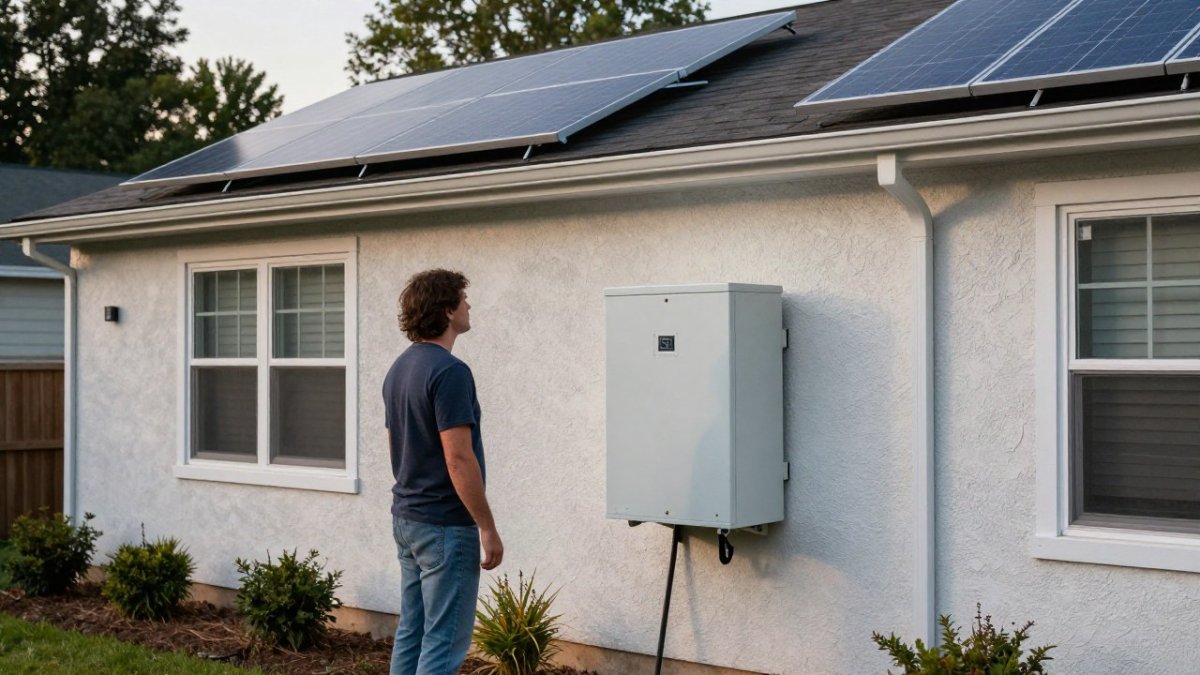
A homeowner in a suburban Tennessee backyard stands beside a wall-mounted home battery and a rooftop solar array at dusk.
Battery-backed systems usually cost more than panels alone, and the size you need depends on your loads.
How Long Can a Home Battery Power a House During an Outage?
Runtime depends on battery capacity and what you run. A battery that stores 10 kilowatt-hours can run a refrigerator and some lights for many hours. Central air conditioning draws far more power and will run for much less time. Solar recharging during the day can extend that runtime.
- Lights and phone charging: low draw, long runtime
- Refrigerator: moderate draw, steady use
- Central air conditioning: high draw, shortest runtime
Planning Realistic Backup Capacity and Essential Loads
Most homeowners overestimate what a battery can run and underestimate what their essentials actually draw. A practical load plan answers three questions: how much energy you need per day, how much continuous power your inverter can deliver, and how much sunlight your area receives during the outage. Get those three numbers right and runtime stops being a guess.
Build a load list with real numbers
Start with the appliances you cannot do without and record two figures for each: running watts and hours per day. Use the nameplate rating or a plug-in watt meter for accuracy. A common pattern for a modest backup panel looks like this:
- Refrigerator: roughly 100-200 running watts, cycling about 8 hours per day
- LED lighting (six fixtures): about 60 watts total, 5 hours per day
- Internet router and modem: about 15 watts, 24 hours per day
- Phone and laptop charging: about 60 watts, 3 hours per day
- Sump pump: about 800 running watts, intermittent during storms
Multiply watts by hours and divide by 1,000 to get kilowatt-hours per day. The list above lands in the range of 4-6 kWh per day before the sump pump runs. That is the number to compare against your battery's usable capacity, not its nameplate capacity. Most residential lithium batteries are rated to about 90% depth of discharge, so a 10 kWh battery delivers roughly 9 kWh of usable energy.
Account for inverter output, not just storage
A battery can hold plenty of energy and still fail to start a load. Every backup inverter has a continuous power rating and a short-duration surge rating. A well pump or air conditioner may draw two to three times its running watts for a few seconds at startup. If the surge exceeds the inverter's rating, the load will not start even with a full battery. Check both numbers on the inverter specification sheet before assuming an appliance is covered.
Factor in sunlight and weather
Solar production during an outage is not the same as your annual average. Panels produce little or nothing at night, and output drops sharply under heavy overcast or snow cover. A common planning approach is to size the battery for at least one full day of essential loads with no solar input, so a cloudy first day does not leave you dark by evening.
Decide what "whole home" really means
Whole-home backup is possible but requires a battery bank and inverter sized to your service panel and your largest loads, and the cost scales accordingly.
Watch out: sizing a battery from nameplate wattage alone without accounting for surge and duty cycle is the most common planning error, and it typically shows up on the first hot or stormy day of an outage.
Booking a Backup Power Assessment for Your Home
If you want to see what your home needs, book a backup power assessment with our licensed team. We will review your current system, your critical loads, and your outage risks, then explain your options in plain terms.
Frequently Asked Questions
Do solar panels work during a power outage?
Not by default. A standard grid-tied solar system shuts down during an outage because its inverter must stop exporting power to the utility grid, a safety rule known as anti-islanding protection. This protects utility workers who may be repairing lines that they assume are de-energized. The panels still generate electricity in daylight, but the inverter cuts that power off from your home. To keep solar power running during an outage, the system needs battery storage or a backup-capable inverter with a dedicated backup circuit. A licensed electrician can confirm whether your existing system supports either option.
Why is my power out if I have solar panels?
Most grid-tied solar systems are designed to disconnect from the grid during outages. When the utility grid fails, the inverter detects the loss of voltage and shuts down to keep line workers safe. Your solar panels may still be producing power, but the house is dark because the inverter is offline. Adding a battery, a transfer switch that isolates critical loads, or a hybrid inverter with backup capability allows part of your home to stay powered. Ask your installer to show you the outage sequence for your specific equipment.
Can I use my solar panels during an outage without a battery?
Only if your system includes a backup-capable configuration. Some hybrid inverters and backup gateways can isolate a set of critical circuits and power them from the panels during daylight without a battery, though output depends on sunlight and the inverter's rated capacity. Without a battery or backup hardware, a standard grid-tied system will not power your home during an outage. Solar output also drops at night and during heavy cloud cover, so a battery is usually needed for dependable backup.
How long can a home battery power a house during an outage?
Runtime depends on battery capacity in kilowatt-hours, the power your critical loads draw, and how much sunlight recharges the battery. A battery that stores 10 kWh will run a refrigerator, lights, and internet equipment far longer than it will run central air conditioning. Load management, which limits power to high-draw appliances, extends runtime. Work with your installer to calculate runtime from your actual essential loads, not the battery's advertised size alone.